Wednesday, August 08, 2007

Josh Funt checks in

Our first cousin once removed, Josh Funt, the oldest son of Wendy Felenstein, checked in from Sarasota FL by email after having discovered this blog, probably after learning of it from his aunt Marsha. Here is the text of his email, along with a great photo of his family.

It's wonderful to hear from you, Josh. Needless to say, we're excited to learn the location of Grammy's Walter Ruby scrapbook, and hope to be able to post scans of some of the photos and clippings here. -- Danny

This is Josh, Wendy Felenstein's son. I was the recipient of a number of items when my mother died that are directly related to this blog. I have an old scrapbook that has clippings of Walter Ruby's accomplishments, and I also have a number of items from Selma.

These things are unique and I treasure them. There are a number of pictures of Walter Ruby from the days of Errol Flynn and Clark Gable. He has that studio type portrait and it looks so like the old 8X10s from that era. I also have a number of clippings showing the invention of Rum and Coke as well as some of his manufactured inventions revolving around the spirits business.

I love what you did with the family history and it is very cool to learn about the old history of our family.

I have saved this blog as a favorite and I plan to revisit it often. I keep in touch with Marsha and Robert, but I am not really in touch with anyone else on Joan's side of the family.

I would be happy to scan and send you some of the items I have. Let me know if you are interested.

All the best to you all.

Josh

Monday, July 30, 2007

Walter emails from Rostov

Dan and Jo,

We are in Rostov having a great time with warm and wonderful people. It is also close to 100 degrees and havent had a chance to swim in the Don which is clean only intermittently. I am also very tired, so only a brief note for now. There arer, sadly, fewer mentions of Tulbowitzes than I had hoped. The problem appears to be that Rostov did this super-wonderful census in 1896 that would have had all sorts of terrific information on them, but as you know, Rose, Abe and Sophie left for US in 890 or 1891 and the rest of the clan left within a few years, so there werte none of them left in '96. Couldnt Shlomo-Aharon and company have held on for a year or two to get into the census? They ought to have anticipated some great-son would show up 110 years later seeking info on them. Maybe they did, but Rose said, "Get your asses in gear and come to Albany." The family may have also been metioned in earlier records that have, lamentably, disappeared. So we have had bad luck in this regard.

The syangogue archivist, Yevgeni Gimududinov found two precious bits of info on the Tulbowitzs We bought the documents from the municipal archives, so will be able to put them up on Ruby Family History at some point. One from 1876 records the birth of a son to Shlomo-Aharon and Sophia (not Sophie as she is recorded on her grave) by the name of Gavriel. Not Eduard, who probably was born in 1878 as the U.S. census said. Gavriel's brithday is Sept 28, 1876 and it is also recorded that Gavriel was circumcized on Oct 3, 1876. The documents gives the rank of "Meshanin" or "townsman" to Shlomo-Aharon. That was a rank that included professionals, artisans, and small business people that was a lower ranking than "merchant". Interestingly, we saw a newspaper later today from 1874 where all the meshanins in Rostov are listed and there is no Tulbowitz there, so maybe the family was rising from poverty and just attained that status in 1875 or 1876. Dan, you mentioned that the U.S. census record about the family said there wete five children (Rose, Edward and who else?) Was the name Gavriel or Gabriel among them? Anyway, meet another family member.

The second listing was from Aug 13, 1879 and records the death of a son named Isai or Yitzhak, aged 3 years and 5 months. So Sophie must have gotten pregnant again almost immediately after giving birth to Yitzhak. Strange--but thats what we have. So meet another family member who was only with us for a short time.

We have a LOT of information on the Jews of Rostov at that time, of the synagogue and cemetery (now gone) and much, much else. But it looks like we'll be leaving here having added only marginally to the concrete knowledge of Tulbowitz's-on-Don. Still, it was very much worth the trip, just being here absorbing the milleu and seeing a city that was down at the heels when I was last here in 1999, now bursting with prosperity--a mini-Moscow. The transformation is incredible. We had dinner at a Cossack restaurant (really!!!) in a recrerational area on the Don last night and the place was full of flashy people flashing cash. Russia is indeed bursting with pride and money.
Anyway, I drank way too much and danced like crazy and then had to get up early for a day of geneological research. Am headed now for a much needed nap.

Love,

Walter

Thursday, July 19, 2007

last pix from Brenners


a few more photos from Brenners--people and critters


Stan's birthday ,occasion at Brenners and forthcoming quest to Rostov, Vilna and Kovno


Dear Dan, Jo and world,

I am extremely exhausted tonight, preparing for my forthcoming trip to the former Soviet Union (Kiev, Rostov, Moscow, Minsk, Vilnius, Kaunas on trip to research our families in Rostov and Lithuania, but felt the need to put at least something up here on the occasion of what would have been Stan's 83rd birthday. We all miss him terribly and it would have been wonderful to share with him the joy of our geneological hunt into both sides of his family, which has succeeded beyond all expectation in terms of where we were at soon after his death when we started this project. My biggest excitement recently was finding in a book at Yeshiva University in NY that Rabbi Isaac Elchanan Spektor was the grandfather of Joseph Rabinovitch and ttherefore our great-great-great grandfather. Stan always told me we were descended from Rabbi Spektor, but only recently, when reading the biography of Rabbi Spektor by Rabbi Efraim Shimoff, based on Toldos Yitzhak, by Yitzhak LIfshitz, Rabbi Spektor's secretary, did I find the exact connection. According to the book, my great-grandfather Yosef Rabinowitz (or Rabinovich) was the grandson of Rabbi Spektor and the son of Chaim, the rabbi's oldest son. According to Lifshitz, when Chaim died at the age of 40 in 1874, Rabbi Spektor took charge of his grandson, then 19 and taught him Talmud and Jewish Codes and found him a bride. (According to U.S. census records, her name was Lena Lincoff and the newlywed couple emigrated together to New York in 1875, where they had 9 children, the youngest of was our grandfather, Walter Rabinowitz (b 1893), who changed his name to Ruby at the time he was being inducted into the U.S. Army in 1917 and sent to fight in France.

I have learned a lot also about Rabbi Spektor's role as the chief shdadlan (negotiator) with the Czarist government on behalf of the Russian Jewish community after the beginning of the pogroms of the 1880's, and his outreach to the leaders of West European Jewry (the Rothschilds and many others) to pressure the Czar to lay off the Jews (A lot of these messages were written in a kind of code so as to throw off government spies) and his gingerly embrace of the Hibbat Tzion (Lovers of Zion) movement, the first stirrings of Zionism in Russia that came 15 years before Theodor Herzl. So the great rabbi has come alive and as a very sympathetic and complex character. But I digress...

Tonight, we think of Stan and all of his wonderful qualities and zest for life and the wonderful legacy of values and insight he has left for us. We hope that our lives since your passing, Dad, including this quest, would do you proud and hope that somehow, somwhere you may be aware of all of this. I know it goes against all of your theories and convinced athiesm, but what the hell...

Last weekend, Tanya and I had a enjoyable and meaningful reunion at the home of Sandy and Mel Brenner of some of the surviving members of the older generation of Ruby relatives; Mel and Sandy Brenner, still going strong at 82 and 78 respectively, Marsha and Shelly, Robert Felenstein and wife Jane and Janice Brenner, the radiant ballerina. As viewers will notice, none of us are as young as we once were, but everyone was lively, upbeat and full of the wisdom of having kicked around this planet for a while. We had a delicious lamb roast, drank wine, talked about many things, including politics. Mel reminisced about having been a McGovern delegate in 1972 and there was a group effort to try to understand why this country has elected so many Neanderthal Republicans over the past 40 years. It was wonderful to reconnect to the liberal passion that was such a part of the lives of Stan and Helga and has been passed down to myself, Jo and Danny and to Janice as well. Excellent values, if I do say so myself. Many thanks Stan, Helga, Mel and Sandy for passing them along to us. Maybe they will come back into fashion in 2008. Too bad Stan and Helga had to leave us during the darkest period of Bushism. But to cite Ted Kennedy and Helga, "The cause goes on and the dream will never die..."

By the way, Sandy recalled that our great-grandmother Rose Ratner always reminsced with her about Rostov that it was the most beautiful city in the world and showed us a set of dishes collected by her mother Til decades ago, each emblazoned with a Rose in memory of her beloved mother, Rose Ratner.

How did 150 plus years of our family get from the shtetl to where are now? Well, I think I have to plunge back into the shtetl to understand some of that, so I'm playing guinea pig for that role. I'll be posting on our findings in Rostov and Lithuania when we return on August 8 or perhaps while we are there if we find a working computer. In the meantime, lehitraot and enjoy the photos I am putting up here from the get-together in Massapeaqua. (I'll put up a few more in subsequent posting).

Tuesday, May 15, 2007

Walter's visit to Piedmont and Los Gatos

I am just completing a wonderful three days here with Dan, Jo, Bill, Lani, Twyla and Maxine and a large cast of League of Wmen's Voters members (I was about to write 'ladies', but the League has gone thoroughloy co-ed, so the president of the Southwest Santa Clara League is now a man). Jo and I spent Saturday with the Southwest Santa Clara League members at a retreat in which one member, Dale Hill, was awarded the Helga Ruby Outstanding Member award. This was the first year the award has been given, but it will be an annual affair. It was a moving occasion for Jo and I to see and hear from so many League members about what a critical role Helga played for them as a League activist, and in many cases, as mentor and friend. Sadly, I was all too often disinterested when Helga told me about her involvement in a succession of Leagues (Pittsburgh, Chicago, Los Gatos) over a period of decades, and only got interested on one of two occasions in her last year or two, when I suddenly realized that I have become very interested in grass roots politics covering it as a reporter, and here was my mother delving into it in great detail and full of passion for so many years--and I hadn't paid attention. But now I'm contemplating finding out my local League in New Jersey and getting involved. (note to readers: last summer Walter returned from Israel saying he had decided to make aliyah, so we'll believe this thing about joining the League when we see it).

Then Jo and I had a mellow afternoon in Los Gatos visiting Helga and Stan's close friends Suzanne and Jo and then to the trippy 'Halfway to Heaven' house of trippy Charlie Walton, filled with wired electronic contraptions, including an electric train montage that could lowered from the ceiling at the push of a button, and with majestic views over the Valley and surrounding mountains. We also went for a short hike on the mountainside that one gazed at from Stan and Helga's place on Overlook Drive. Altogether a deeply enjoyable 'return' to Los Gatos, which somehow has gone on with its unhurried existence without Stan and Helga.

The rest of my visit included a serious hike with Jo in that wonderful endless preserve in the hills overlooking Oakland; a visit to the cemetery, where we paid on the ground beside our parents gravestone and told stories about them; three terrific dinners, one in a Thai Restaurant and one superb meal each cooked by my gourmet siblings; Dan did a shish-kebab thing with the lamb perfectly cooked and suffused with all the right spices and Jo did a marvelous shrimp and rice dish. We had a lot to catch up on in terms of who is doing what--a lot of the story of Lani and Jo's all-but -certain move to Paris in September, where Lani will attend the International School, and Dan's recent trip into the heart of darkness of a red neck music festival down in the deserts of southern California. We made a 'dent' in going through boxes of photos and artificats of Stan and Helga, but honestly a rather small dent. There was a lot of nachas all around concerning the achievements and plans of Twyla, Gene, Zach and Lani.

So it was wonderful, relaxing, theraputic and a chance to come closer as a family both as we look back on our wonderful parents, but also as we look to the future.

Wednesday, January 31, 2007

288 Pleasant Ave--home of Joseph and Lena Rabinowitz in 1900

Back in mid-August, I left the following posting on RFHP:
Wow--the 1900 census has Joseph born in about 1855 and Lena in 1857, which is really getting back there. Lena is 36 when she has Walter, her last of 8 children (one deceased). They reside at 288 Pleasant Ave. in Manhattan, wherever that is. A deluge of info--but I have to stop now because must get up and finish writing a story tomorrow.

so I finally did a Mapquest and, yes, Virginia, there IS a Pleasant Ave. in Manhattan, in East Harlem, exactly where Stan said they lived. It is the easternmost street in that part of Manhattan, running N-S between 114 and 120th streets. 288 is between 115 and 116. Will definitely go and see it--if it is still standing--the next time I cross the Triborough.

Saturday, January 06, 2007

RFH document available for download

The draft Ruby Family History document is now available for download as a pdf file. Use the link in the sidebar at right. We'll be adding access to the other document and artifact files listed in the near future.

Tuesday, December 12, 2006

Blogger upgrade enables categories

I upgraded to the new version of the Blogger software today. This will allow a variety of improvements, which I will look at later. But I've already implemented the most important new feature. We are now able to categorize our blog posts according to labels we define. I've quickly gone through and assigned labels to all our old posts. We may want to refine the label wording and assignments later, but already you can go to the label listings in the blog sidebar and select any one to view just the posts relevant to that subject. Any future posts can be assigned to one or more of the existing labels or given a new one.

One immediate conclusion from looking at the results is that we have only scratched the surface in producing content for the blog. Maybe that will inspire us to put some new energy into the project.

Tuesday, October 31, 2006

Journal publishes Stanley Ruby obituary


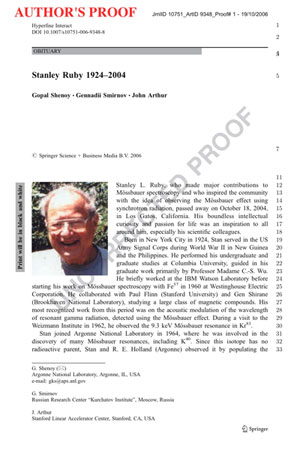
Here is the Stanley Ruby obituary from Hyperfine Interactions, as downloaded from the Springer-Verlag library of scholarly journals. Thank you to Gopal Shenoy for making this happen and keeping us informed. It is wonderful to have this assessment by three of Stan's peers of his impact in the physics world.


OBITUARY
Stanley Ruby 1924–2004
Gopal Shenoy & Gennadii Smirnov & John Arthur
© Springer Science + Business Media B.V. 2006
Hyperfine Interact
DOI 10.1007/s10751-006-9348-8


Stanley L. Ruby, who made major contributions to Mössbauer spectroscopy and who inspired the community with the idea of observing the Mössbauer effect using synchrotron radiation, passed away on October 18, 2004, in Los Gatos, California. His boundless intellectual curiosity and passion for life was an inspiration to all around him, especially his scientific colleagues.

Born in New York City in 1924, Stan served in the US Army Signal Corps during World War II in New Guinea and the Philippines. He performed his undergraduate and graduate studies at Columbia University, guided in his graduate work primarily by Professor Madame C.-S. Wu.

He briefly worked at the IBM Watson Laboratory before starting his work on Mössbauer spectroscopy with Fe57 in 1960 at Westinghouse Electric Corporation. He collaborated with Paul Flinn (Stanford University) and Gen Shirane (Brookhaven National Laboratory), studying a large class of magnetic compounds. His most recognized work from this period was on the acoustic modulation of the wavelength of resonant gamma radiation, detected using the Mössbauer effect. During a visit to the Weizmann Institute in 1962, he observed the 9.3 keV Mössbauer resonance in Kr83.

Stan joined Argonne National Laboratory in 1964, where he was involved in the discovery of many Mössbauer resonances, including K40. Since this isotope has no radioactive parent, Stan and R. E. Holland (Argonne) observed it by populating the 29.4 keV excited nuclear state by means of deuteron bombardment (K39(d,p)K40). Later, Stan and D. H. Vincent (University of Michigan) excited the K40 resonance through the neutron capture reaction (K39(n, +)K40).

Argonne provided an ideal setting for Stan. He could incubate his ideas with colleagues who helped them blossom into successful experiments. He actively worked with a large number of scientists from different divisions at Argonne, with backgrounds in nuclear physics, materials science, and solid state physics. This was essential for establishing new Mössbauer resonances and finding the best techniques to unravel nuclear, chemical and solid state properties. In particular, his collaboration with Michael Kalvius, Bobby Dunlap and Gopal Shenoy led to many publications dealing with resonances in Sn119, Sb121, Te125, I127,129, U238, Np237, Am243.

Stan will be best remembered for his proposal in 1974 to excite the 14.4 keV Mössbauer resonance in Fe57 using synchrotron radiation rather than a radioactive source to populate the nuclear excited state. Stan struggled for years to develop techniques for separating the nuclear resonant X-rays from the overwhelming background. In the early 1980s, Stan moved from Argonne to the Stanford Synchrotron Radiation Laboratory with the sole desire to succeed with his idea. Although it was the group of Erich Gerdau that first achieved this goal in 1985 at DESY, Stan and the SSRL group followed in 1987 and proceeded to make important contributions to this new field.

During the period 1990–1995 Stan and the Stanford group collaborated closely with scientists from Russia (Kurchatov Institute) and Germany (Munich Technical University) in a series of experiments at SSRL and CHESS. They observed and explained several surprising features of the coherent nuclear exciton created by a synchrotron pulse in a nuclear sample, such as the extreme speed-up of the nuclear exciton decay in scattering from a multilayer, and the nuclear exciton echo induced by vibrating a portion of an excited sample. They were also the first to use synchrotron radiation to excite the narrow 6.2 keV Mössbauer resonance in Ta181. Stan was particularly concerned with the conceptual problem of understanding “when and where” the interaction of X-ray photons with nuclei occurs during the propagation of radiation pulses through a target.

Fundamental physics was central to Stan’s life, though his interests ranged from cosmology to biology. While he allowed that quantum mechanics was useful for calculations, he found it very unsatisfactory on a philosophical level. During his later career, and especially after his retirement, he worked hard to find simple, alternative explanations for quantum phenomena. Stan was young in soul, always individualistic and passionate about his scientific ideas, which sometimes touched very exotic fields. His mind was most acute when he was talking, so he was eager to sit and talk about his latest ideas.

These discussions were always interesting, involving physics, history, astronomy, and politics. Stan’s lifelong concern with the impact of science on society was expressed in his leading role in the campaign against anti-ballistic missiles during the 1970s. Beyond his consuming interest in physical science, his many pursuits included international travel, outdoor recreation, marine life, and observing the human parade.

He was truly a family man and took an avid interest in the lives of all his colleagues. He is survived by his wife of 57 years, three children, and four grandchildren. His friends on several continents will miss him. We remember Stan for his never-fading enthusiasm to discuss physics with anyone who would listen, his friendship, and above all his curiosity for new ideas.

G. Shenoy (*)
Argonne National Laboratory, Argonne, IL, USA
e-mail: gks@aps.anl.gov

G. Smirnov
Russian Research Center “Kurchatov Institute”, Moscow, Russia

J. Arthur
Stanford Linear Accelerator Center, Stanford, CA, USA

Monday, October 23, 2006

The younger Sharons

Photos from Walter in Israel.

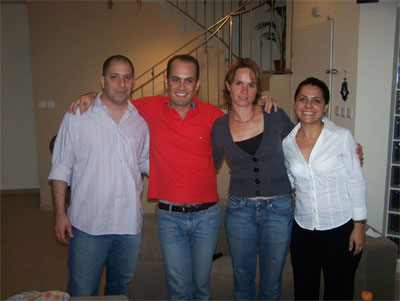
Tal, Achikam, Dalit, Gali (left to right) in Achikam and Gali's lovely new suburban home in Kfar Yona north of Tel Aviv.

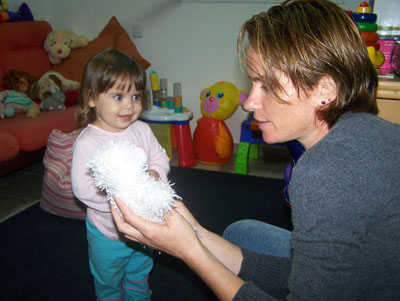
Little Netta (Achikam and Ali's daugher) with Aunt Dalit

Sunday, October 22, 2006

Moving tribute

This is an e-mail I just send to Joanne after reading her wonderful tribute to Stan on his yahrzeit, but then I thought what the hell, I'll put it up on the family history blog as well. Catching a moment in time for posterity and all of that.
Walter

Jo,

Just read your enormously moving tribute to Dad and broke into tears sitting in my hotel room in Jerusalem. You are so right that the view from their gravesite evokes Hodel's farm--thanks so much for the image. And thanks so much for your compassion and love for our parents and your ability to grieve for them in such a deep and profound way on behalf of all of us. Zeh mashehu dai chashuv, something deeply important that you are doing on a cosmic, existential level that is impacting the world far beyind what we can see and discern (as you can see Israel effects me in all osrts of unexpected ways.

You have warmest regards from the whole Sharon family. I got to visit Achikam's house and hang out with him and his lovely wife Gali and baby girl Netta. Dalit and Tal were there also. Spoke to Pnina, who is pressing Ahikam to travel with her to her birthplace in Belarus as well as Raya, who leaves this weel for a vacation with Amiram in northern Italy. Once homebound in Afeq, they have all turned into world travelers. Anyway, the one question that everyone asked of me (it was more of a demand than a question) was "WHEN IS JOANNE-EE COMING? MATAI HE TAVO? ANACHNU KOL KACH OHEVIM OTAH." So what can I say? You better get on a plane over here ASAP! Dan, the Israeli branch of the family would all love to see you as well.

OK, am on a deadline and must run. I put some of my writing on the Russian conference on rubyjewsday; now I have to write another piece on Lieberman (Avigdor, not Joe), whbich is due immieditely for Jewish Week.

Love,

Walter

Saturday, October 21, 2006

Remembering Stan's last days


Joanne writes:

Standing by his gravesite, I was flooded with my still very vivid memory of Stan's last week. It started on my 50th birthday (Monday) -- not being able to take him home as was the discharge plan, but instead to the hospital. I drove him -- my very, very sick father with a failing heart and failed kidneys sleeping next to me. I remember it feeling a bit surreal; like this could be it, he could go out on me right there rolling up 280, his all time favorite highway, past SLAC, to the exit for Stanford Hospital.

He rallied and made it: a ‘rolling admission” (hospital variety not college) – an in-and- out stay for the very sick elderly who come in from a nursing home and are discharged quickly back to the nursing facility. The dialysis was keeping him going, but not for much longer they predicted. We gathered family and friends.

I invited Peggy, of the Good Death Institute, to meet Stan. He had been so quiet and withdrawn. I just had this sense that if he could become aware of his imminent death, he might choose to use the time he had. He had struggled so desperately his last months with his want to have time, to be awake, not to be asleep when he had so much to write, read, say, share. It had been driving him crazy; how his bio-ryhthms were so out of whack. How the kidney failure affected his cognitive process. As a child with my own sleep issues, he had so stressed the joy of being awake. It just seemed right to bring him this woman who helps the dying person die a good death.

Peggy met him on Saturday afternoon 4ish. Stan had been quiet all day, closed eyes, not responded to anyone including cousins Sandy & Mel, Joe, Gene, Helga, me. Peggy held his hand, rubbed it, told him I'd invited her, and that she came to talk about his heart. He opened his eyes. Looked straight at her and said, “My heart? I can tell you a lot about my heart, but you should hear about my kidneys.” Within minutes Stan was alert, upright, and fully engaged, as we all know he can be, and then asked, 'Who are you?" In finding out she was not a doctor, or nurse, but rather a person who talks with people before they die, Stan looked genuinely puzzled, and said, “die”. “Do you think I’m going to die?”

Peggy later told me she’d never in 20 years of hospice work met a person like Stan, so unaware of dying, and found him absolutely remarkable, brilliant, funny, witty and loveable all at once. They talked about the ways of death, of rituals, of the middle ages, of the big bang and the origins of the universe. Stan, said repeatedly, “I am so enjoying this. Thank you so much, Jo, for bringing her to me. But what do I call you? I need a name for you. I know, I’ll call you the ‘warner’”. He pleaded with Peggy to come back as soon as possible.

She said she’d be there Monday after his dialysis and could stay for a few hours. It was stunning. To have Stan back, his brain woken up, his intellectual curiosity aroused. Most incredible was that Stan was bright on the phone in the morning, and when I arrived Sunday afternoon, he wanted to talk more about the Einstein article in Scientific American. He watched football with Zach and Bill and Dan. He talked to Twyla and Lani. He stayed engaged. He was present. He was looking forward to the next day: Walter was due to arrive at noon, he would go with Stan would go to dialysis, Peggy was coming after that.

Thursday, October 19, 2006

Stan's science legacy


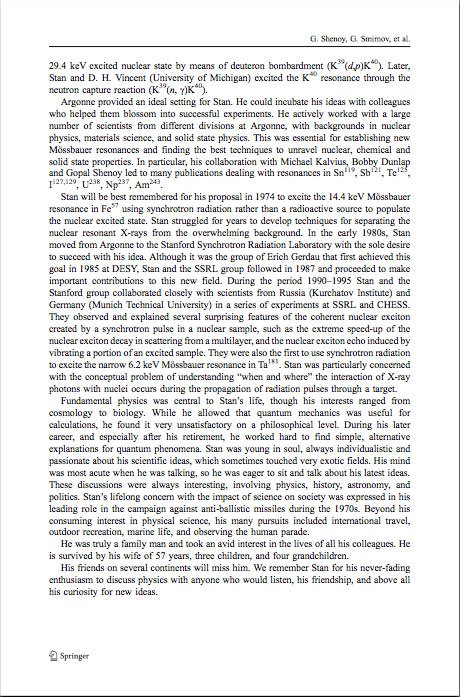
We received a wonderful email today from Gopal Chenoy, a long-time colleague of Stan's from Argonne days who we Ruby kids remember well from his many meals and overnight visits at our home. His message said that the physics journal Hyperfine Interactions would be publishing a tribute to Stan's work in physics written by himself, John Arthur, and Gennaddi Smirnov, two other colleagues. He attached pdfs of the author's proofs of the article, which are reproduced here.

The article puts Stan's legacy as a physicist as clearly as anything we have seen. Here are some excerpts:


His most recognized work from this period [early 1960s] was on the acoustic modulation of the wavelength of resonant gamma radiation, detected using the Mössbauer effect. During a visit to the Weizmann Institute in 1962, he observed the 9.3keV Mössbauer resonance in Kr83.

Stan wil lbe best remembered for his proposal in 1974 to excite the 14.4keV Mössbauer resonance in Fe57 using synchrotron radiationrather than a radioactive source to populate the nuclear excited state. Although it was the group of Erich Gerdau that first achieved this goal in 1985 at DESY, Stan and the SSRL group followed in 1987 and proceeded to make important contributions to this new field.

Fundamental physics was central to Stan’s life, though his interests ranged from cosmology to biology. While he allowed that quantum mechanics was useful for calculations, he found it very unsatisfactory on a philosophical level. During his later career, and especially after his retirement, he worked hard to find simple, alternative explanations for quantum phenomena.


As well as reviewing Stan's scientific accomplishments, the article gives an appreciation of him as a co-worker and man in the world. After the article appears in the journal, I'll put up a link to it or reprint the text. Gopal says he has also submitted a proposal for a longer article on Stan's science legacy that has not yet been accepted for publication.

All of this was wonderfully timely, since we're observing Stan's Jahrzeit this week. Joanne has lately visited with several of Stan and Helga's close friends. She and I will go to synagogue to say kaddish tomorrow. I'll ask Joanne if she wants to post some of her thoughts.

In the meantime, thanks so much to Gopal for this unexpected gift today.

Wednesday, August 30, 2006

Walter's Israel journal (Part 6): Coming home


This is the final installment of Walter's report on his recent Israel trip. Although it only peripherally about our Israeli relatives, it sounds as if it could be the opening of a new chapter of Ruby family history.

As for myself, I made a decision during my two days visiting my cousins in Afeq and sitting with residents in the air raid shelters of Haifa; namely that someday in the not-too-distant-future I will return to live in the hometown of my youth, stricken now, but still achingly beautiful as it sits resplendently on the steep slopes of Mt. Carmel.

Over 25 years ago, I made a decision not to stay permanently in Israel despite my abiding love for the land, the people, the Hebrew language and the primal intensity of the place. I felt myself too much of a cosmopolitan Jew to stay permanently in a place that then seemed to me parochial and intensely nationalistic, and I was unready to join the IDF and take part in enforcing an occupation of the West Bank and Gaza that I found to be fundamentally wrong and immoral. Or so I rationalized it to myself then, yet somehow I have known in my bones during all the ensuing years that Israel is where I belong.

And then suddenly last week, listening to my aunt Penina narrate the story of our family and the role they played in the rebirth of the Jewish commonwealth in the land of our forefathers, and listening to Orly Magen express her profound distress on the emotional toll that the latest outburst of violence is exacting on her Etai and whole new generation of Israelis, I vowed to myself that I will return to Haifa to devote the remaining years of my life to doing whatever I can to help transform conflict into reconciliation so that the next generation of Jews and Arabs, Israelis, Palestinians and Lebanese alike, will not have to endure the horrors that have scarred the lives of this generation and the four generations of Israelis and Arabs preceding it.

Suddenly I remembered two things I knew long ago but had somehow since forgotten; that underneath their hard-edged and sometimes truculent exteriors, Israelis are kind, decent and profoundly vulnerable. Also that despite the hell visited upon it by recurring wars, the tiny jewel-like Land of Israel is the most radiantly beautiful place on earth. It is where I belong.

Walter's Israel journal (Part 5): An odd sense of normalcy


Away from the war zone, Walter finds life goes on in Tel Aviv and Jerusalem.

Like almost every Israeli to whom I spoke, Magen (see previous post) said she supports the government’s decision to press on with its military offensive to the Litani River, some 20 miles north of the Israeli-Lebanese border, although, like nearly all the others, she is dubious the expanded offensive will bring lasting peace or end the missile threat that had turned their lives upside down. When the cease-fire was announced several days later, there was an almost unanimous feeling that it would last only a matter of hours or days and then violence would erupt again.

The three quarters of the Israeli population that lives south of Hadera in the region where the missiles have yet to penetrate live in a jarringly different reality than their compatriots further north. In Tel Aviv, Jerusalem and elsewhere in the center and south of the country, life goes on more or less normally. People sit in cafes or to the beach as though the whole nightmarish scene happening a few score miles to the north simply does not exist.

A slogan emblazoned on an electronic billboard overlooking the main Tel Aviv-Haifa highway proclaims, ‘Residents of the North, we are all with you’, yet the slogan seems at least partly hyperbole. When I informed friends in Jerusalem that I had just spent two days in Afeq and Haifa before coming to the capital; most responded with comments to the effect of, ‘You were brave to have done that, but I wouldn’t go there myself in this situation.’

Most of those to whom I spoke seemed to feel they are in enough danger and under enough stress given the reality they are forced to live with in relatively peaceful times as well as times of war—that they don’t need to go in for false heroics. It is enough that they go to work every day to keep the economy running—not to mention being ready, if fate so decides, to sacrifice their children for the good of the country. In addition, many have opened their homes to refugees from the north. So why, they ask, should they go north and dodge missiles themselves?

Walter's Israel journal (Part 4): An encounter in the shelter


Walter hears the sad story of a young Israeli mother.

Inside the hot, dank and overcrowded shelter, Orly Magen, a harried-looking woman of about 25, sat dejectedly in the corner, holding her two and a half year old son Etai. Asked about her situation, Magen explained that several weeks earlier her husband had been called into the reserves and the office where she is employed as a clerk sent its workers home for the interim of the conflict.

After several days in which she and Etai were forced to take shelter ten or more times a day during incessant air raids, Magen decided to take her toddler to Tel Aviv and stay with acquaintances there until things calmed down in the north. Yet after a week, and a half, Magen felt that she had worn out her welcome, and with her meager bank account dwindling rapidly, she was in no position to move into a hotel. Instead, she drove back to Haifa with Etai, and moved in with her mother in the building in which the Hadassah members took shelter (see previous post).

A few days later, a missile landed nearby, totally demolishing Magen’s car. She has been assured by a government official that she will eventually be reimbursed a large portion of the value of the car, but, for the moment, she has no idea when the money will come. After narrating her story in matter-of-fact fashion, Magen’s voice quavered as she said, “I can’t stand any more of this. Etai is being traumatized by the constant air raids and the boom of the rockets when they hit. The situation is completely unbearable.”

Several of the Hadassah women hugged Magen and placed into Etai’s eager hands presents like stuffed animals, crayons and coloring books. Smiling broadly through her tears, seemingly for the first time in days, Magen profusely thanked the visitors and said, “It means a lot to me that there are Jews from America who are willing to come here despite the dangers and be with us at this moment.”

Walter's Israel journal (Part 1): At Kibbutz Afeq


Here is Walter's report after his recent visit with family members at Kibbutz Afeq, which took place during the war with Hezbollah when bombs were falling in the north of Israel. I've broken his article into several pieces for readability. For more of Walter's observations from Israel and Ukraine, see his Ruby Jewsday blog.

I was having lunch with my 87 year old aunt Pnina, her daughter Raya and son-in-law Amiram in the communal dining room on Kibbutz Afeq, listening to Pnina reminisce about how her husband, 89-year-old family patriarch Ze’ev, a refugee from Hitler’s Germany journeyed to the Land of Israel as a teenager in the mid-1930’s and, together with other members of his Zionist youth group, helped to found the kibbutz and to plant orange groves on land located on the coastal plain between Haifa and Acre that was then mostly sand dunes and malarial swamps.

Penina talked movingly about how she herself escaped the Nazi invasion of Poland as a young woman by fleeing to Soviet Russia, where she was interred for several months in a prison camp in Siberia before being allowed to emigrate to Palestine. Finally she spoke about the desprate struggle for survival that was Israel’s War of Independence in 1948, and how Ze’ev and other members of a platoon from Afeq took part in house to house fighting in the battle to capture the ancient seaside city of Acre from Arab forces during the 1948 War of Independence.

Suddenly my absorption in Pnina’s narration of a piece of our family history I have heard many times before but which never fails to fascinate me, was pierced by the unmistakable wail of an air raid siren. Manifesting no discernable sign of alarm, Penina said, “OK, we’ll finish our meal in a little while, but right now we need to get up and walk quickly to the shelter”. So I followed my dynamo of an aunt and about 30 other kibbutzniks out of the dining room and down a flight of stairs to a smallish space underneath the stairwell of the building; an alcove which, it appeared to me, would offer only minimal protection to its occupants in the event of a direct hit by a katushya missile.

We stood against the walls of the shelter for about five minutes, with the kibbutzniks socializing and discussing the latest developments in the war, and then, without waiting for an ‘all clear’ signal, walked back up the stairs and concluded our meal.

As we tarried over coffee and ice cream, I asked Pnina how it felt to have survived the onslaught of the Nazis and the rigors of a Soviet prison camp; to have experienced seven Israeli-Arab wars, including the 1973 Yom Kippur War, during which one of her three children and her her only son, Avinoam was killed; to have participated in the building of a kibbutz from swampland into a thriving entity and to have watched her beloved Israel grow from a struggling entity of 600,000 Jews to one of six million, only to find herself having to run to an air raid shelter in the sunset of her life.

She paused for a moment to consider the question in all of its weight and then said, “Look, I don’t appreciate having to run for the air raid shelter five or more times a day as we have been doing here for the past three weeks, and sometimes I ask myself why I bother to take shelter at all, because I am going to die soon enough anyway. But then I say to myself, ‘I don’t want to give those Hezbollah bastards the satisfaction of killing me.’ So I get up from whatever I am doing when the alarm sounds and head for the shelter.’”

Monday, August 14, 2006

AP: Famous ancestors adorn most family trees

Here's an interesting article from the Associated Press that says that almost everyone descends from a famous ancestor. In our family, that could be the Kovno Rav. The article goes into detail about actress Brooke Shields' pedigree. Among her ancestors are Catherine de Medici and Lucrezia Borgia, Charlemagne and El Cid, William the Conqueror and King Harold II, vanquished by William at the Battle of Hastings.

Even more surprising, according to Irish computer scientist and genealogy enthusiast, Muhammad, the founder of Islam, appears on the family tree of every person in the Western world. Who knew?

Sunday, August 13, 2006

Twyla turns 21


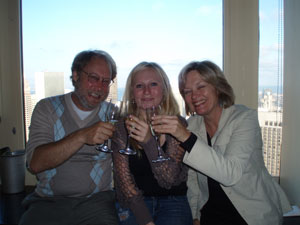
Stan and Helga's first grandchild turned 21 a few days ago. Here's a photo of Twyla, her mom Kate, and her dad Dan enjoying a toast and the view from San Francisco's Top of the Mark.