Showing posts with label Ringels of Berlin. Show all posts

Friday, April 06, 2012

Germany and restored citizenship

Joanne and Walter have been talking for some time about the possibility of Helga's descendants having the option of obtaining dual German citizenship based on Helga's status as a displaced former citizen. I have regarded that possibility with skepticism, but prompted by my latest health insurance woes my two siblings have gone to the trouble of learning the German law.

Walter spoke with an official at the German consulate in New York and found that all the relevant information is here. The applicable law reads: "Former German citizens who between January 30, 1933 and May 8, 1945 were deprived of their citizenship on political, racial, or religious grounds, and their descendants, shall on application have their citizenship restored."

The information page continues with the following explanation:
Between January 30, 1933 and May 8, 1945 there were basically two laws pertaining to the loss of German citizenship. With the 'Law on the Revocation of Naturalizations and the Deprivation of the German Citizenship' of July 14, 1933, some persons were deprived of their German citizenship individually. Their names were listed in the Reich Law Gazette ('Reichsgesetzblatt') and with the publication of the particular Reichsgesetzblatt they lost their German citizenship.

The main group of former German citizens, however, lost their citizenship with the 'Eleventh Decree to the Law on the Citizenship of the Reich' of November 25, 1941. This stipulated that Jews living outside Germany could not be German citizens. This mainly affected Jews who had left Germany in the years before or shortly after the beginning of the Second World War.
I recently came across a listing of our Aunt Hilda, Elly's sister, having her citizenship revoked by name, but the second paragraph is the one that would apply to Elly Ringel and her daughter Helga. Walter writes that the official told him that if we have the proper documentation (and we do), then we could become citizens of Germany and of Europe within a year of filing the application.

What that means for any of us Rubys remains to be fully considered, but it is certainly interesting to understand that acquiring European citizenship (presumably without renouncing U.S. citizenship) is a realistic option for any of Helga's children and grandchildren.

Saturday, July 11, 2009

"Tracing Ringel family roots"

Shalom, It is Danny here adding my deep sympathies for all of Ze'ev's wonderful family. I regret that I have not visited you in all these many years and that I did not renew my connection with Ze'ev before his passing.

One small contribution I can make is to review some of the knowledge of the Ringel family history that I gained during my research project into our family roots. Sad to say, that work has been on hold for most of the past year, but this solemn occasion might be the catalyst for me to take up that work again, just as our initial project was set in motion by the deaths of parents, Helga and Stan.

So here is some of what we learned: Ze'ev's grandparents on his mother's side were Schija Ringel (1856-?) and Feigla Kauffler (1854-1921). Schija was a merchant who had came to Berlin from Rzeszow in Galicia as a young man. It was not uncommon by the second half of the 19th century for Jewish youth to be leaving their traditional towns for the progress and opportunities of cosmopolitan cities.

Similarly, Feigla had come from Krakow to make a living as a housekeeper. She came to work for Schija in that role, but their relationship later became personal. Their first child, Herman, arrived in November 1885, though they didn't formalize their marriage until July 1888. Later they would have two other children, Bette and Rosa.

Your family members will know much more than I do about Rosa's family, and also Bette's, and I would love to learn more from you about Ze'ev's life story, as well as what you have learned about his cousins Edith and Gina. About Hermann, we know that he served in World War I, became prosperous in the garment business, married Elly and had a daughter Helga. Walter's account of Helga's early life is very rich (link below). There are some good photos on the blog (links below). Hermann died of natural causes in Berlin in 1938, and his widow and daughter fled Germany soon after, eventually settling in New York in 1942.

[Ruby Family History text (Helga's story begins on page 35): http://www.festivalpreview.com/files/RFH7.pdf
[Page with photos and documents for Hermann Ringel: http://rubyfamily.blogspot.com/search/label/Ringels%20of%20Berlin]

Going back in the other direction, we have located official records from their ancestral towns for both Schija and Feigla and a number of their relatives. Schija's birth record (link below) does not provide a great deal of information, but we see that his parents are Moses and Rose. I also have similar records for several other Ringels that are not posted on the blog. Another artifact in my possession is a copy of the yizkor book for Rzeszow, which does not have specific information on the Ringels, as far as I can tell, but paints a rich picture of life in the town in the 19th century. There are also census records that I have not yet obtained. As I say, there are lots of loose ends and I hope to post more of this information on the blog sometime soon.

[Schija Ringel birth record: http://rubyfamily.blogspot.com/2008/07/schija-ringel-birth-record.html]

Information about the Kaufflers in Krakow is much more extensive, and we can trace our ancestors back quite a few generations to Nachman Kaufler (born in Krakow in 1755). Nachman had Izaak, Izaak had Schulim, and Schulim had 10 children including Abraham Mojzesa Kaufler (b. 1829). Abraham married Chaja Esther Grunberg (b. 1826) and Feigla was one of their three children. An assortment of vital records are linked below. The full Kaufler family tree is provided in a link below.

[Feigla Kaufler 1854 birth record: http://rubyfamily.blogspot.com/2008/07/first-lds-document-arrives.html]
[Schulim Kaufler and Reisel Bluma Singlust 1825 marriage record: http://rubyfamily.blogspot.com/2008/07/schulim-kaufler-and-reisel-bluma.html]
[Schulim Kaufler 1847 death record: http://rubyfamily.blogspot.com/2008/07/schulim-kaufler-death-record.html]
[Bayla Kaufler 1831 death record (mother of Schulim): http://rubyfamily.blogspot.com/2008/07/bayla-kaufler-death-record.html]
[Kaufler family tree: http://rubyfamily.blogspot.com/2008/06/major-breakthrough-kaufler-family-tree.html]

In the coming days, I plan to post news of Ze'ev's passing along with stories and images from Joanne and Walter. If there is anything that any of you might wish to contribute to our small memorial, especially text that helps to fill in his life story, I would appreciate that very much. In the meantime, I hope this little bit of Ringel family information is interesting and helpful to you.

With great sorrow for the passing of our elders but great hope for our children and their future,

Danny

Friday, July 25, 2008

Schija Ringel birth record image

The hits keep on coming. Marian Rubin's package arrived today with four printouts of Ringel birth records from the Rzeszow archives. I'll have some comments about this later. For now, feast your eyes on the June 13, 1856 birth record of another of our great grandparents, Schija Ringel, the man who would later move to Berlin, marry Feigla Kaufler, and raise three children, Hermann, Rosa, and Bette Ringel.

Schija's record is highlighted. Click to enlarge.

Sunday, July 06, 2008

Ahikam Finkel expands our tree

Woo hoo for second cousin Ahikam Finkel, who accepted Joanne's invitation to our family tree on Geni and has input family information for our Sharon relatives in Israel. This fills in some important details on our Ringel side and adds wonderful new details about our Israeli cousins.

Rosa Ringel's husband, the father of Ze'ev Sharon, was David Shatner, also the brother-in-law of our grandparents Hermann and Elly. That name might help me in future research about our family in Berlin.

We also get previously unknown details about Ze'ev's wife Penina. She was born Penina Dorfman Feb. 15, 1919 in Poland. Her parents were Izik Dorfman and Sara Bahat.

Ahikam is the son of Raya Finkel, the daughter of Ze'ev and Penina. He is 33 years old, married to Gali and has a daughter Neta.

To view our tree on Geni, contact me for an invitation to join our family group.

Thursday, June 05, 2008

Feigla Kaufler's birth record

Krakow Births 1798-1855,71-89
Krakow Wojewodztwa / Krakow Province

Surname Givenname Year Type Akt Film Indexfilm Date House
KAUFLER Feigla 1854 B 188 718917


The right name, location and year. Photocopies can be obtained from a collection in Israel, and I sent in an order.

Tuesday, June 03, 2008

Translation reveals Hermann's parents were unmarried

I should have posted this in March, but better late than never.

The German translator came through and we now have more information about Hermann's parents, including something unexpected. Here are the highlights:

Hermann Ringel's birth record shows he was born November 5, 1885 in Berlin, that his parents were Schija Ringel and Feigel Kaufler. Kaufler was Ringel's unmarried Jewish housekeeper. A notation on the birth record from two and a half years later indicates that Schija and Feigel married on July 2, 1888.

Feigel's death certificate from November 28, 1921 (three years before her granddaughter Helga's birth), describes her as 67 years old, a shopkeeper, born in Krakow and residing at the same address in Lothringstrasse as her son Hermann.

Hermann's death record from June 25, 1938 is pretty spare, and does not appear to tell us anything new.

Sunday, August 06, 2006

Translation update

Rather than sending Walter the hi-res files, I decided I should finally get translations done for the two German documents--Hermann's birth certificate and a 1925 death certificate for an unknown Ringel--that were not previously translated. The birth certificate is heavily annotated with additional information from 1888, three years after the certificate was originally issued. The names of the mother and possibly the father are indicated but are difficult to decipher in the handwritten German script.

I googled for German translation services and found one that handles small personal jobs as well as corporate and legal work. I emailed them yesterday and heard back right away from someone asking for more details on the project. I sent off low-res copies of the documents and am waiting to hear more from them.

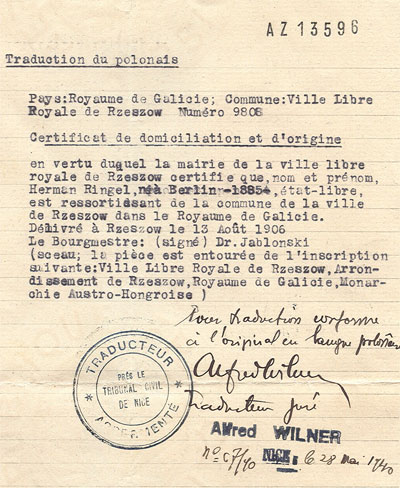
There is one other document for which we need an English translation, Hermann Ringel's 1906 Polish language "domicile of origin" certificate. My German translators don't do Polish, but it doesn't matter because we already have French translation of the document, done perhaps in 1940 in Nice. I will reproduce a closeup of that document (below) that may be legible even in the blog.

But first, here's a theory. Elly carried the Polish domicile record and presented it in France to support her claim of Polish citizenship and use of a Polish passport. Closer inspection of the passport seems to indicate that it was issued in Toulouse in France on July 5, 1940 and would expire after one year. So this suggests that Elly used Hermann's domicile record as documentation to acquire the passport from a Polish consulate in France.

Anyway, the French translation follows. If anyone can render that into English, it would be most helpful.

On the Kurfürstendamm


I had trouble with the display of this photo in the post below and decided it deserved a post of its own: Hermann and Helga on the Kurfürstendamm in about 1934.

Saturday, August 05, 2006

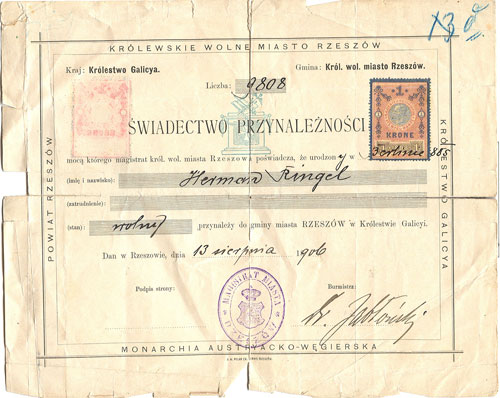
Hermann Ringel documents


Doh. He was born in Berlin in November 1885. Then the family returned to Galicia, and then he came back in 1906? There are still some mysteries here to unravel. For one, we have not yet had anyone translate the birth certificate, and especially the handwritten annotations.

Here are Hermann's birth certificate and relocation document. I've made them as large as possible in the blog, so I'm sorry they are not very legible. Hopefully I will also be able to get higher resolution versions to Walter.


The Ringel dossier


I just spoke to Walter, who departs tomorrow for his trip to Israel and Ukraine. The family gathering day is supposed to be Tuesday, though he is unsure if the latest round of bombings got close to Dalit and Tal's town of Zichron Yachov. I can't wait to get Walter's report on the reunion. Don't forget to take lots of pictures.

To prepare for the meeting, I need to supply Walter with copies of the Hermann Ringel birth certificate and relocation permit, as well as various photos for him to share with the Israeli relatives. The problem is that the documents are really big files--what's the best way to get full-resolution images to him over the wire?

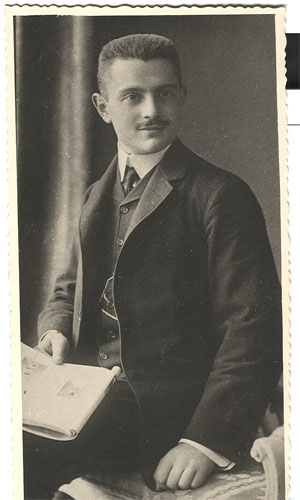
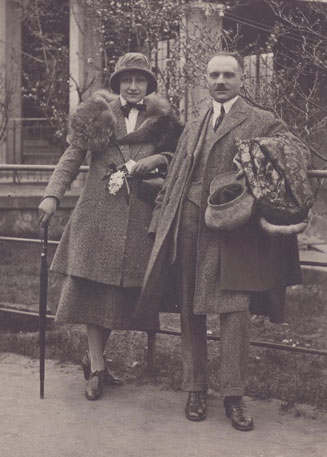
While I mull that over, I'll go ahead and post the pictures that I want to share. Here we have: Hermann Ringel, Herman and wife Elly, Hermann and daughter Helga, Elly's mother Bette Katz (we think), and an unknown Ringel woman (possibly Rosa, Bette or Margot). Only Ze'ev will know any of the people in the pictures, and it sounds as though it is doubtful Walter will be able to see Ze'ev, since he is not well enough to travel from the kibbutz, which is within the war zone.


Thursday, August 03, 2006

German Jews in WWI

The other day I posted information about the military draft in the U.S. for World War I. Our grandfather Walter Ruby registered in the draft, was called up, and fought and was seriously injured in the war. Our German grandfather, Hermann Ringel, also fought in the war on the other side.

I was curious about German Jewry and its response to the war, so I dipped into Amos Elon's "The Pity of It All--A Portrait of the German-Jewish Epoch, 1743-1933" for these excerpts:

"When war actually broke out, five weeks after the assassination, middle- and upper-middle-class urban Jews did not 'go home.' They joined up. By volunteering for war sevice long before being called up they hoped they would finally overcome the remaining informal impediments to full integration in German society....

The common experience of war was generally expected to cement firm new bonds among Germans of all faiths. The term used for that experience was Erlebnis. A young Jewish volunteer, Julius Holz, invoked his Erlebnis on December 7, 1914, his twentieth birthday, in a letter to his father from the front. He vowed to 'fight like a man, as a good German of true Jewish faith and for the greater honor of my family.' ...

In the main urban centers, liberal, leftist, and perhaps even some pacifist Jews were swayed by the prevailing emphasis on Russia. It was easier to endorse a war directed against the last despoitic and openly anti-Semitic regime in Europe....

In a speech he gave on August 4 affirming his government's decisio to go to war, the kaiser solemny assured his audience by proclaiming that differences of religion, political affiliation, class, and ethnic origin no longer counted. He said: 'I no long know any aprties, I know only Germans,' at which point the Reichstag broke into a 'storm of bravos.' ....

Jewish volunteers and conscripts felt very little hostility in the ranks. In the name of the kaiser's 'civic truce,' the military authorities ordered the more radical anti-Semitic periodicals to refrain from anti-Jewish agitation.

The Zionists were still a negligible minority among German Jews. At a conference just sight weeks before the war, they had reaffirmed their conviction that they were aliens in Germany. Once war was declared, though, they joined in with as much--and often more--enthusiasm than others, ready if necessary to shoot at French or Russian Zionists.

The Zionist Judische Rundschau, in its first issue after the outbrak of war, exhorted reader to volunteer unhesitatingly and en mass....

German Zionists already settled in Palestine hurried back to volunteer....

Large parts of the Pale of Settlement in Russia soon came under German military rule. Nearly everywhere, Russian Jews welcomed the German troops as liberators....

[Lots of great detail about Jewish pro-war sentiment, including from Freud and other intellectuals, followed by rising disillusionment as the war dragged on.]

Far from unitying Germans and Jews, the ware seemed only to deepen the gulf between them. As soon as the war turned sour, chauvinism turned inward....

Such feelings were exacerbated by the sudden influx of impoverished Jews from occupied Poland and Russia. Living in abject conditions on the edges of the larger cities, they elicited revulsion....

In October 1916, when almost three thousand Jews had already died on the battlefield and more than seven thousand had been decorated, War Minister Wild von Hohenborn saw fit to sanction the growing prejudices. He ordered a 'Jew census' in the army to determine the actual number of Jews on the front lines as opposed to those serving in the rear....

The Jew census had a devastating effect on German Jews, generating an unprecedented moral crisis among those on the front line....

In 1914, Eranst Simon had fully shared the 'intoxicating joy' of going to war. The Jew census was a 'betrayal:' the dream of community was gone. In one horrendous blow, the census reoped the deep chasm that 'could not be bridged by common language, work, civilizaton, and custom.' ....

Only two years earlier, Nahum Godmann had hailed the gloried of Prussian milarists and their wonder war. Now he wrote that Jews had nothing to do with this war: its origins, its aims, its content were totally alien to them. It was taking place outside their sphere.....
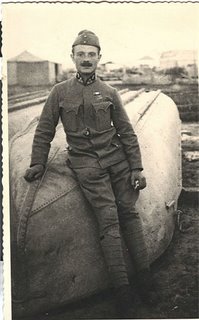

[I'll stop there. This book has lots of great content about Jewish life in Germany until it was obliterated by the Nazis. I'll return later with excerpts about the Zionist movement and also the Jewish reaction to the rise of Hitler. For now here is a photo of Hermann Ringel in uniform as a German soldier during WWI.]