Showing posts with label Walter Ruby. Show all posts

Friday, September 24, 2010

American Spirits boss Sidney Kessler


In Walter's "The Early Lives of Stan and Helga Ruby" document, we learn from Sandy Klein's memories that Walter Ruby's "partner" in Carioca was a man named Peter Siskind and that at some point the two men joined American Spirits, presumably bringing their product with them. The document goes on to report that after Walter's death, Siskind and a new partner Sidney Kessler owned the company until selling it to Schenley in 1946.

There are some things right and other things wrong about that account. The following excerpt from "Through the Sands of Time: A History of the Jewish Community of St. Thomas" has lots of detail about Kessler's activities in the U.S. Virgin Islands, including not-so-veiled hints that he made his fortune as a bootlegger. This article says it was Kessler who founded the Carioca distillery in Puerto Rico, which sounds right, but in 1938, which we know is wrong.

[For some reason, I can't get my image of the chapter to display larger than it is at right. Click it twice to read it in full size.]

I think it is likely that Kessler was the main mover behind American Distilling Co., and that American Spirits was the distribution and marketing agent for American Distilling in the United States. In a 1946 legal report on a stockholder lawsuit against American Distilling, the ownership of American Spirits is described as 50% owned by American Distilling and 50% by two of the defendants, Peter Siskind and Sidney Kessler.

Anyway, the excerpt reveals a good deal of fascinating information about Kessler, including his later activities as a major real estate developer in St. Thomas. Enjoy.

Thursday, September 23, 2010

We Had Em All the Way!

Dan,

Brilliant work! I'm pretty sure thats what got him fired. That's two times Coca Cola comes into Ruby family lore and things turn out badly; let's not forget that our great-grandfather Abraham Bloch (Walter's eventual father in law, who was in the seltzer business in Albany around 1910) was offered the franchise for upstate new York by a small upstart company from Atlanta that offered a syrupy new carbonated drink and he said, "Naw, I've got more than enough business already." For the rest of his life, whenever he had an idea or made a suggestion, people would say, "Yeah, yeah, and you're the guy who said no to Coca Cola." I drank a Diet Coke today (eveybody in Georgia still seems to drink Coke in support of the home team) and it tasted kind of weird to think of all the pain and grief those corporate SOBs caused our family!

On a happier note, see this New York Times article on Bing Crosby's vintage taping of Game 7 of the 1960 World Series, which ends, of course, with Bill Mazeroski's epic game winning blast! 50 years ago in just a couple of weeks! Time flies when you're having fun. Certainly that was one of the very happiest moments of my life; the purest ecstasy and exaltation. The unheralded, scrappy Pirates upending the mighty imperial awful Yankees. Sublime justice for at least one moment. Miracles do come true, after all.

To paraphrase the Passover song: 'If the only great moment in my life had been Maz's homer slaying the Yankees, that would have been enough!' Not really of course, but its a good line.

Did Coca-Cola endorse the Carioca Cooler?


Walter just called from Savannah GA, where he is on a mixed work-pleasure trip with Tanya, to discuss the latest Walter Ruby developments. I read to him the following expanded version of the snippet published in the previous post, which I had since managed to piece together from multiple searches in Google Books.

You will note an interesting article in connection with the first Fall meeting of the IBA, which meeting was addressed by a well-known wine and liquor authority, Mr. G. Selmer Fougner.


This article leaves no doubt that the Carioca Rum Company is very closely associated with the Coca Cola Company in the promotion of a drink known as the Carioca Cooler. The presence of Mr. Homer Thompson of the New York Coca- Cola Bottling Company, at this meeting, is further indicative of the association.


Naturally, the writer is at quite a loss to understand your statement to him at the time of our meeting several months ago, at which you stated definitely that the Coca-Cola Company had no association whatsoever with the Carioca Rum Company and, as a matter of fact, had secured an injunction against these people for the use of the Coca-Cola name and facsimile of the bottle in their advertising."


Appellee's attorneys, in replying to said letter, denied the association with the Carioca Rum Co. referred to in the letter, but attention is called to it here for the reason that, if appellant's selling agent believed that appellee was interested in a beverage containing rum, it is altogether likely that purchasers of appellant's goods bearing the mark ...

Walter's immediate response: "That's what got him fired."

I hadn't gotten there yet, but it sure sounds right. Consider the timeline.

Walter is managing the Carioca advertising campaign for American Spirits in 1935-6, using an apparent tie-in with the Coca-Cola company. In addition to the cocktail labels published previously, above is the front and back of a miniature Carioca bottle that is available for sale on an Internet auction site.

Not only is Coca-Cola's name and logo prominently used, the Carioca Cooler's own branding mimics the Coca-Cola typography.

Then Walter abruptly leaves the company for unknown reasons. This very interesting snippet from the publication Printers Ink in 1937 shows the company reassigning its advertising account, presumably after Walter's departure.


Then we have the expanded snippet cited above, which appears to come in a legal filing in an 1940 appellate court case involving Coca-Cola's relationship with American Spirits and the Carioca Cooler. It is unclear who is the appellant and appellee.

As Walter the younger speculates, our early-day Don Draper of a grandfather didn't have authorization from Coca-Cola for his hot new marketing idea but went ahead with it anyway. Then the beverage giant sues or brings the hammer down in some other way on American Spirits, Inc. and Walter Ruby is forced out of the company as a result.

For those who didn't get the reference, Don Draper is the lead character in the television series Mad Men about a self-made man in the advertising business in New York the 1960s. Walter Ruby is a self-made man in the advertising business in New York in the 1930s.

By the way, the G. Selmer Fougner mentioned above was a prominent food and wine writer who had a daily column in the New York Sun, the first of the breed of foodie journalists so prevalent today. When you think of the characters like Fougner and songwriter Harry Ruby with whom our Walter crossed paths, it does seem like an episode of Mad Men.

Wednesday, September 22, 2010

Wanted. Name of bon vivant who discovered new rum drink!


Believe it or not, the title of this post was one of the advertising slogans that American Spirits, Inc. registered with the U.S. Copyright Office in 1935 in support of its premium rum brand, Carioca.

Or how about this one? "Who discovered the Carioca cooler?" That's a gimme for anyone in our family. It's Walter Ruby, the vice-president of marketing for the selfsame American Spirits. But why is he writing advertising copy about himself?

Take a look at the whole list of copyrighted phrases. It's from the Library of Congress 1935 Catalog of Copyright Entries, part 1, volume 32 and it turned up as a snippet in a Google Books search.


Then here are two more snippets relating to the history of this drink, the first from an advertising trade journal in 1938 and the second from a court ruling published in a federal legal register in 1940. Both snippets leave you wanting more, but these excerpts are all that is available without tracking down the full documents.

"That such is the fact is mostly because American Spirits, Inc., who sell Carioca Rum, saw an opportunity to identify their fledgling with mighty Coca-Cola and started plugging a mixture dubbed Carioca Cooler back in 1934. Carioca Cooler ..."

"This article leaves no doubt that the Carioca Rum Company is very closely associated with the Coca-Cola Company in the promotion of a drink known as the Carioca Cooler. The presence of Mr. Homer Thompson, of the New York Coca-Cola ..."


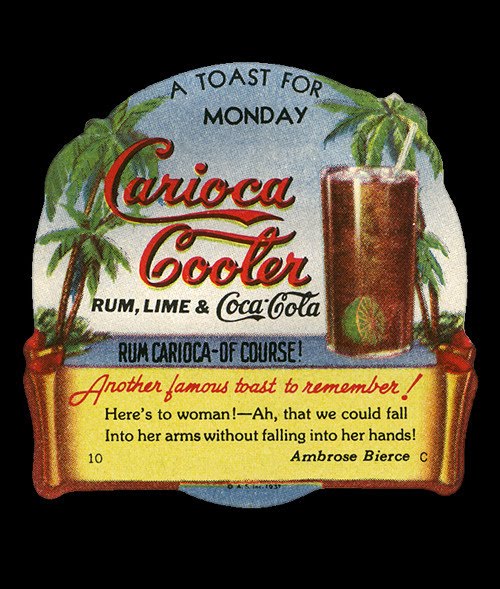
Finally, the great graphical cocktail labels at the top of the post are from a collection on the site Arkiva Tropika. They look to me like coasters, and they have these corny toasts on them. Plus, there's the Carioca Cooler recipe right there. These are for Monday and Wednesday. I wonder if there were five more.

Wednesday, July 29, 2009

Harriet's package arrives

Harriet Berkowitz followed through on her promise and yesterday I received her package containing about 20 photocopies of her family photographs. In many cases, these are the first photos we have seen of Rabinowitz family members. There are also new photos of our father and his parents that are new to us, plus the promised invitation to Stanley Ruby's bar mitzvah. Together they begin to paint a fuller picture of the Rabinowitz family.

It is going to take me a few days to get the images all scanned and processed. Here is a start. Click on the images to enlarge.


Joseph Rabinowtiz


Lena Rabinowitz with Arthur's wife Anne, apparently at a beach club.

Brothers Henry (also called H.V. Lee) and Julius Rabinowitz flank their cousin Harry Lincoff.


A young Selma Ruby with either Joan or Stanley Ruby as an infant. (Sorry this is cock-eyed. My scanner is having trouble with the oval image.)

Invitation with elaborate menu for Stanley Ruby's bar mitzvah in 1937 at the Hotel Ocean Crest in Long Beach. The menu even includes liquor brand selections, such as Carioca rum served with hors d'ouevres.

Wednesday, August 08, 2007

Aborted visit to NY Public Library

I keep meaning to spend time researching microfilm of New York newspapers from the 1920s for more details on Walter Ruby's exploits during prohibition. As you may recall, we have NY Times articles about his 1922 indictment and the later dismissal of those charges, as well as an intriguing mention of him as a boxing manager.

I've been to New York twice now in recent months and both times was frustrated in my efforts. In April, the library was closed for a Jewish holiday the day I was there. Last week, I was very busy during my two days in the city and managed to get to the library just 45 minutes before closing. Most of that time was consumed learning how to retrieve microfilm and how to operate the machine.

So I had precious little time to get to the actual work. I did manage to find one relevant article, from the August 15, 1926 edition of the New York Herald Tribune, reporting on the dismissal of the Catrow case. There was no new information in it, but it reinforced my determination to read more newspapers, especially the tabloids, from that date and several others when Walter Ruby made news.

I'm not sure when I'll next be in New York, but when I am I will schedule a whole day for microfilm research.

Thursday, July 19, 2007

Stan's birthday ,occasion at Brenners and forthcoming quest to Rostov, Vilna and Kovno


Dear Dan, Jo and world,

I am extremely exhausted tonight, preparing for my forthcoming trip to the former Soviet Union (Kiev, Rostov, Moscow, Minsk, Vilnius, Kaunas on trip to research our families in Rostov and Lithuania, but felt the need to put at least something up here on the occasion of what would have been Stan's 83rd birthday. We all miss him terribly and it would have been wonderful to share with him the joy of our geneological hunt into both sides of his family, which has succeeded beyond all expectation in terms of where we were at soon after his death when we started this project. My biggest excitement recently was finding in a book at Yeshiva University in NY that Rabbi Isaac Elchanan Spektor was the grandfather of Joseph Rabinovitch and ttherefore our great-great-great grandfather. Stan always told me we were descended from Rabbi Spektor, but only recently, when reading the biography of Rabbi Spektor by Rabbi Efraim Shimoff, based on Toldos Yitzhak, by Yitzhak LIfshitz, Rabbi Spektor's secretary, did I find the exact connection. According to the book, my great-grandfather Yosef Rabinowitz (or Rabinovich) was the grandson of Rabbi Spektor and the son of Chaim, the rabbi's oldest son. According to Lifshitz, when Chaim died at the age of 40 in 1874, Rabbi Spektor took charge of his grandson, then 19 and taught him Talmud and Jewish Codes and found him a bride. (According to U.S. census records, her name was Lena Lincoff and the newlywed couple emigrated together to New York in 1875, where they had 9 children, the youngest of was our grandfather, Walter Rabinowitz (b 1893), who changed his name to Ruby at the time he was being inducted into the U.S. Army in 1917 and sent to fight in France.

I have learned a lot also about Rabbi Spektor's role as the chief shdadlan (negotiator) with the Czarist government on behalf of the Russian Jewish community after the beginning of the pogroms of the 1880's, and his outreach to the leaders of West European Jewry (the Rothschilds and many others) to pressure the Czar to lay off the Jews (A lot of these messages were written in a kind of code so as to throw off government spies) and his gingerly embrace of the Hibbat Tzion (Lovers of Zion) movement, the first stirrings of Zionism in Russia that came 15 years before Theodor Herzl. So the great rabbi has come alive and as a very sympathetic and complex character. But I digress...

Tonight, we think of Stan and all of his wonderful qualities and zest for life and the wonderful legacy of values and insight he has left for us. We hope that our lives since your passing, Dad, including this quest, would do you proud and hope that somehow, somwhere you may be aware of all of this. I know it goes against all of your theories and convinced athiesm, but what the hell...

Last weekend, Tanya and I had a enjoyable and meaningful reunion at the home of Sandy and Mel Brenner of some of the surviving members of the older generation of Ruby relatives; Mel and Sandy Brenner, still going strong at 82 and 78 respectively, Marsha and Shelly, Robert Felenstein and wife Jane and Janice Brenner, the radiant ballerina. As viewers will notice, none of us are as young as we once were, but everyone was lively, upbeat and full of the wisdom of having kicked around this planet for a while. We had a delicious lamb roast, drank wine, talked about many things, including politics. Mel reminisced about having been a McGovern delegate in 1972 and there was a group effort to try to understand why this country has elected so many Neanderthal Republicans over the past 40 years. It was wonderful to reconnect to the liberal passion that was such a part of the lives of Stan and Helga and has been passed down to myself, Jo and Danny and to Janice as well. Excellent values, if I do say so myself. Many thanks Stan, Helga, Mel and Sandy for passing them along to us. Maybe they will come back into fashion in 2008. Too bad Stan and Helga had to leave us during the darkest period of Bushism. But to cite Ted Kennedy and Helga, "The cause goes on and the dream will never die..."

By the way, Sandy recalled that our great-grandmother Rose Ratner always reminsced with her about Rostov that it was the most beautiful city in the world and showed us a set of dishes collected by her mother Til decades ago, each emblazoned with a Rose in memory of her beloved mother, Rose Ratner.

How did 150 plus years of our family get from the shtetl to where are now? Well, I think I have to plunge back into the shtetl to understand some of that, so I'm playing guinea pig for that role. I'll be posting on our findings in Rostov and Lithuania when we return on August 8 or perhaps while we are there if we find a working computer. In the meantime, lehitraot and enjoy the photos I am putting up here from the get-together in Massapeaqua. (I'll put up a few more in subsequent posting).

Sunday, July 30, 2006

Immigrants in military service

I remembered I have a great book on the World War and American society that I acquired for family history research, Over Here by the historian and former Stanford University president David M. Kennedy. I've just begun to dip into it, but here's a striking passage, during a section on the political debate in 1917 about universal service, also called conscription:
Shared military service was the only way to "yank the hyphen" out of Italian-Americans or Polish Americans or other imperfectly assimilated immigrants. "The military tent where they all sleep side by side," Theodore Roosevelt preached, "will rank next to the public school among the great agents of democratization." Compulsory military training, said a Representatiove in 1917, "is a melting pot which will ... break down distinctions of race and class and mold us into a new nation and bhring forth the new Americans"

More later if the book has anything specific to the Rabinowitz and Ratner men as the country prepared for war.

Saturday, July 29, 2006

The Jersey City Rubys

Good news, I've found a plausible Walter Ruby in New Jersey for the 1920 census, a good bet to be the young man who will be in a car accident in Jersey City 15 years later. He is Walter Ruby, 25, one of three Ruby-surnamed stepsons of Thomas Fahey of Jersey City Ward 10. This Walter Ruby was born in New Jersey of parents born in New York, like the one from the 1930 census. He is listed as being a clerk with a steel company.

Anyway, it puts to rest the whole double life scenario. Wild goose chase indeed. By the way, it is amazing just how many Walter Rubys there were with birth dates in the 1890s. There are WRs in Nebraska, Kentucky, Alabama, and several other places, in addition to the one in Manhattan and the one in Jersey City.

The Jersey City mystery deepens

Remember that among the New York Times clippings about Walter Ruby that I discovered last year there was one that reported an auto accident taking place in Jersey City on June 14, 1936. A car driven by a Walter Ruby, age 41, of 110 Cottage Street in Jersey City, collided with another car, resulting in six injured people. One of the injured was Evelyn Ladd, 52, of the same address listed for Walter Ruby.

This article has been a continuing mystery. Perhaps it is a different Walter Ruby, though the age is about right. If it is our Walter, why does he have an address in Jersey City? I had came to the conclusion at that time that the reporter had made an error and gave the Cottage Street address for Ruby, particularly since I had interpreted the article as suggesting that Mrs. Ladd had been a passenger in the other car. My explanation was that our Walter was passing through Jersey City, perhaps on business, had an unfortunate accident, and that the news report was mistaken about his address.

So today I am looking at census records available at Ancestry.com. Earlier I already described the 1930 census record for the Ruby household at 685 West End Ave. Now pops up another 1930 census record for a Walter Ruby, listed as a boarder in a Jersey City household with Edmund and Evelyn Ladd.

This is six years before the accident at a different Jersey City address, but obviously if Walter Ruby were a boarder with Evelyn Ladd in 1930, the same Mrs. Ladd must have been in his car in the accident. So my explanation about the mistaken address is not correct. The obvious explanation is that it is a different Walter Ruby.

The one thing that continues to raise an eyebrow is that the Jersey City Ruby lists his industry as "jobber," the exact term listed for the West End Ave. Ruby. Is there any possibility that our Walter conducted business in Jersey City and kept a room there for occasional times that he needed to sleep over? If someone kept a part-time apartment in addition to his family home, is it possible he could have been counted twice in the 1930 census?

But there are a few more anomolies about the Jersey City listing. This Walter Ruby is listed as being 36 years old on April 30, 1930, which would have been correct for our Walter. However, he is listed as being unmarried. Also, it says he was born in New Jersey and that his mother and father were born in the U.S. Those facts are obviously wrong. Also, going back to the newspaper clipping, his correct age on the date of the accident would have been 42, not 41.

So what are we to make of this? Almost certainly we are looking at another Walter Ruby. I will go back into the records and see if I can document an earlier history for this other person. But we can't yet entirely rule out the possibility that our Walter Ruby kept an outside apartment in New Jersey for at least six years in the 1930s, and that if so he evidently fictionalized some details about his life despite using his real name.

I'm going to see if I can find anything else that would bring some clarity.

Ancestry.com researches

I mentioned yesterday that I signed up for a 14-day trial period with Ancestry.com. It has proven very useful so far, turning up various census and death records. If it continues to be useful, I will have to consider paying the very expensive membership fee--more than $300 a year or about $40 a month for access to their worldwide databases. I'm going to try to get as much use of it as I can in the trial period.

Two things of note I discovered today. I was doing searches on some of the Ratner children and was able to follow George and wife Emma to Englewood Cliffs, NJ, in 1920, where he was listed as a grocery proprietor. Household members were wife Emma, daughter Marjorie (age 2) and Emma's mother Louise Paeglow. From there I can follow Marjorie into her marriage with Robert K. Decker, evidently known as Ken. Marjorie and Ken appear to still be living at age 89 and 91 at 20 Willow Dr. in Delmar NY, outside of Albany. The phone number listed is 518-478-0208. We know that Marjorie (Stan's first cousin) and Ken had two sons, Kurt and Ronald, but I have not yet been able to find them among the many Deckers with those first names.

But much more exciting than any of that is this morsel, Walter Ruby's draft registration card from June 5, 1917, apparently filled out in his own hand. He lists his name as Walter Ruby Rabinowitz. It provides an exact birthdate for him, October 15, 1893, a datum we may not have had. He lists his occupation as "salesman" with (as best I can make out) Lenox Novelty Co., located at 109 Lenox Ave. in New York City. He is 23 years old and writes that he is a "natural born" citizen.

Here's the image.

Friday, July 28, 2006

Home movie technology


I kept wondering what kind of family had a home movie camera and projector in the late 1920s and early '30s. Here's a tidbit from the history section on Kodak's web page:

"For years, the Eastman Kodak Company had worked to develop a system of movie equipment and film that would be easy enough for the advanced amateur photographer to use, yet reasonably affordable. The result was the Sixteen Millimeter "Cine Kodak" Camera and the Kodascope Projector". The camera itself weighed about seven pounds, and had to be handcranked at two turns per second during filming. A tripod was included in the package, all of which cost a whopping $335.00! And this in a time when a new Ford automobile could be purchased for $550.00."

In 1932, Kodak introduced a new format, Cine Kodak Eight, which made home movie-making more accessible. Here are some photos of what Walter's camera and projector probably looked like. Actually, I can check, since the actual projector is over at Joanne's house. On the other hand, the camera did not turn up in the stash, so we will have to guess which model Walter owned.