So far on this blog we have covered many aspects our family history: our father's family roots in the Russian Pale, the life of the illustrious Rabbi Yitzhak Elchanan Spektor, Jewish life in Harlem and the Bronx, the rise of the American liquor industry in the 1930s, our mother's exodus from Germany and flight to America, the implementation of economic Aryanization in occupied France in the 1940s, and much more. It has been amazing to learn in some depth about these historical periods and events and how our family members' lives, and ours, were shaped by them.
We will now turn our attention to another rich subject that shaped our family and our times, nuclear physics in the postwar period, courtesy of our father Stanley Ruby, who returned home from WWII at age 22 to finish his education and start a career in that burgeoning field less than a year after the first atomic bombs had been exploded at Hiroshima and Nagasaki.
I will warn you that, unlike the histories that we have covered to date, this one will take us into some fairly difficult scientific terrain. I will do my best to make the material understandable to curious readers without dumbing it down entirely. As with the past episodes, we will see how our family member played a role in important historical events and how that involvement impacted his and our lives.
This story begins with a recent trip I made to visit Twyla and Zach at UCLA, where they are both pursuing graduate studies. Twyla's field of science history is near and dear to my own interests, and she graciously allowed me to sit in on several lectures in the class for which she is a teaching assistant this semester, an undergraduate survey of science history from the French Revolution to the fall of the Soviet Union. The professor is Theodore Porter, an expert on the development of statistics and the social sciences in the 19th century. His approach is to understand the cultural, social and political contexts of science history.
I had been reading along with the syllabus since the beginning of the term and scheduled my visit to hear his lectures about science under National Socialism, both in life science (eugenics) and the physical sciences (the Nazi atomic project and V2 rocketry). Among the readings for the week was the play Copenhagen by Michael Frayn, in which a 1941 meeting between two physics greats, Neils Bohr and Werner Heisenberg, forms the central focus. (I had seen the play together with Stan, Helga, Walter and Joanne when it ran in San Francisco in 2002.) Twyla and I spent a good deal of time during my visit discussing interpretations of the play.
I could go on at length on this subject, but the important thing is that my visit left me thinking about the resurrection of German physics after the war. On my return train trip through California's central valley, I recalled that a number of my father's physics colleagues were German. The field that he worked in, exploring the so-called Mössbauer effect, was named for Rudolph Mössbauer, a physicist from Munich who discovered a form of nuclear resonance in 1958 and won the Nobel Prize in 1961.
Taking advantage of Amtrak's on-board Wifi service, I googled to find out if Mössbauer had been the first postwar German Nobel recipient. He was not—Walter Bothe, a participant in the German Uranium Club that became the Nazi atomic bomb project, and the developer of Germany's first cyclotron, won it in 1954, awarded together with Max Born, a Jewish physicist who had fled Germany before the war. After that, Mössbauer was the first.
This rumination led to more searches of various scientists I remembered from Stan's days at Westinghouse (Pittsburgh), Soreq (Israel) and Argonne (Chicago). Mike Kalvius was one who had visited our family a number of times, and I remembered he was also from Munich. I discovered that earlier this year he had co-edited a volume of historical papers celebrating the 50th anniversary of the Mössbauer Nobel.
There are quite a few mentions of Stan in the The Rudolf Mössbauer Story, including in a chapter by Gopal Shenoy, another frequent guest in our home, where he credits Stan for the important suggestion that synchrotron radiation could be a useful replacement for nuclear sources in Mössbauer spectroscopy. That insight, delivered in a paper at the 1974 Mössbauer Conference in Paris, is thought to be Stan's most significant career accomplishment, since synchrotron sources were later shown to be practical and are now commonly used for Mössbauer studies in various fields. (We have previously posted a copy of Gopal's obituary of Stan in Hyperfine Interactions, in which wrote that "Stan will be best remembered for his proposal in 1974 to excite the 14.4 keV Mössbauer resonance in Fe57 using synchrotron radiation rather than a radioactive source to populate the nuclear excited state.")
As I was enjoying this trip down memory lane, I soon received a shock when I began to see references to earlier work by Stan that I had known nothing about. It involved an experiment he had performed at Brookhaven as a graduate student, and it seems something had gone wrong along the way. I'll explain more in the next post.
Showing posts with label Twyla. Show all posts
Showing posts with label Twyla. Show all posts
Thursday, December 06, 2012

Tuesday, June 17, 2008
Ruby family tree is posted on Geni
I signed up with a new genealogy social networking site called Geni and have uploaded a recent version of my Ruby Family GEDCOM file, which now includes 325 names of our ancestors and living relatives.
Geni appears to be a really cool system with loads of great features for displaying information about the family as well as connecting with living family members. To get it rolling, I invited immediate family members and so far Walter, Joanne and Twyla have now signed up. I hope they will be active users by updating their profiles and adding new information to the tree.
If that happens, then let's start inviting various cousins to join in and see what kind of network we can create. If you want to get started on your own, go to www.geni.com and create a free account. Then do a search for any family member you can think of. Once you find the person, you should also be able to find yourself in the Ruby family tree. Link your account to that listing and you will become part of our social network.
Or here's a simpler solution: Write to me at druby@sprynet.com and I will sent you an email invitation to join.
To give you an idea how the program works, here is a sample screen shot:

Tuesday, June 03, 2008
Family attends Twyla's Barnard graduation
Also late, but congratulations are in order for the latest member of the family to pass through the gates of academe and step into the so-called real world. Twyla completed her undergraduate degree from Barnard College at Columbia University, the same institution (Columbia) where her grandfather Stanley was an undergrad and graduate student.
We had a big turnout of Rubys and Eilertsens to celebrate the occasion in New York City. Among Ruby kin, Danny, Joanne, Walter and Tanya, Gene, Janis Brenner and her husband Mitchell Bogart, and Sandy Brenner were on hand for some or all of the festivities. On the Eilertsen side, Kate and Allen, Ed, Judy, and Susie went all out to make the experience special, including at the several special celebratory meals. I was so sad that Stan and Helga could not be there that I broke up trying to say that in a toast at the first celebration dinner.
The graduation ceremony was plenty interesting, with featured speeches by Mayor Michael Bloomberg, David Remnick, Anna Quindlen, Judith Shapiro, and others. Billie Jean King was among those who received the Barnard Medal. Twyla walked with the Anthropology department as she was recognized for her double major in Anthropology and English.
At a couple of departmental receptions, Kate and I had the opportunity to meet two of the professors who advised Twyla's senior project—Ross Hamilton of the English department and Brian Larkin, the chairman of the Anthropology department. Both had lovely things to say about our graduate. Her thesis, "Made Visible: Scientific Constructivism Through the Lens of Hooke's Micrographia, received a 'A' grade from the two professors.
Graduation morning, there was a screwup because I failed to get word to Sandy on where we would meet. She came anyway—solo on the train with Mel in the hospital recovering from a knee operation—but we never managed to find each other. Janis was getting ready to leave for Asia that morning, and the last thing she needed was my frantic call looking for her mother. She ended up missing her flight while Mitchell worked the phones trying to track her down.
Turns out Sandy was there for the graduation ceremony and post reception. Then, not finding any of us, she sensibly went home, where she discovered everyone had been looking for her. My apologies for my part in the screwup. Thankfully, everything worked out okay and Joanne took the next day to visit with Sandy and help get Mel home from the hospital.
Monday, June 02, 2008
Rezekne Family List turns up trove of Tulbowitz kin
Walt, I just looked again at the 1900 U.S. census record for Solomon and Sophie (and Edward) Tulbowitz, and noticed a couple of interesting things. First, the census includes information for "Mother of how many children" and "Number of those children still living." In Sophie's record, the responses are 5 and 3. Second, Solomon and Sophie are both listed as having been married 34 years.
That's a lot of years. Since they were 52 and 49, respectively, at the time of the census, they would have been 18 and 15 at the time of their marriage. I don't remember what we know of exactly when and why they left Rezhitsa. Can you remind me?
On the number of children, I have Rose, Gavriel, Edward and Yitzhak (who died young). That's four, not five. I'm not sure where my information is from, but I have both Gavriel and Edward with a birthday in September 1876. Were they twins? Also, little Yitzhak (Isai) is 3 years, 5 months at the time of his death in August 1879, which does not compute. There are some mysteries there.
Twyla got me started on this today trying to talk up a trip to the Baltics in September. Intriguing idea. She'll have been in Finland with Kate, so maybe I would meet her in Riga and try to take in a circle from Rezhitsa to Kovno to Königsberg.
Anyway, that's what got me looking up Rezekne information today and I surprised myself with what I turned up. I'm not sure why I hadn't found the Tulbowitz stuff before. I guess because I hadn't searched the Latvian SIG. By the way, the info that came from Maxim on Tulbowitz in the all Russia census is also in Jewish Gen, but I have a hard time matching those names with the ones from the Rezekne Family List that I sent earlier.
My working theory is that our ancestor Sholom Ahron Tulbowitz' father Gavriel had a brother Leiba. The two brothers had sizable families that accounted for most but not necessarily all the Tulbowitz population of Rezhitsa.
On Gavriel's side, there were four sons (information is less available about daughters)-- Peisach, Salman, Eliasch (the eldest) and Abram. Peisach married Sara (not Sora?) and had Sholom Ahron, apparently an only child or at least only son. (From there, in our direct lineage, Sholom Ahron married Schifra Ita, also known as Sophie and later Bubbie, and they had Rose Ratner nee Tulbowitz as the first of their five children.)
Piesach's three brothers produced a total of five other sons and at least five grandchildren. Thanks to the Rezekne Family List, I have complete birth dates and spouse names for all of them. Same for Leiba's three sons and their offspring. One reason that branch is interesting is that two of the names Manzik (or possibly Manzin) Tulbowitz (son of Mowscha son of Leiba) and his wife Beila are also on another list of people in Riga with travel documents in 1900.
So that establishes that other Tulbowitz relatives of ours made the journey to America, and presumably accounts for the number of Tulbowitz sightings in places like Bayonne NJ and Wilmington DE. Not all came to the U.S.--a Sergio Tulbowitz is a musician and Marcelo Tulbowitz a professor, both in Montevideo.
The Jewish history of Rezekne is pretty well documented and memorialized, and there is an archivist who seems to be the major expert. He also does videos about Jewish historical subjects. Here is the catalog.
Sunday, August 13, 2006
Twyla turns 21
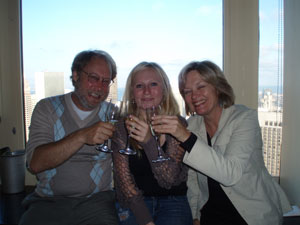
Stan and Helga's first grandchild turned 21 a few days ago. Here's a photo of Twyla, her mom Kate, and her dad Dan enjoying a toast and the view from San Francisco's Top of the Mark.
Subscribe to:
Posts (Atom)