Showing posts with label Tulbowitzes of Rezhitsa. Show all posts

Wednesday, September 15, 2010

Did the Ratner/Tulbowitz family really come from Novocherkassk?


Here is a belated posting, with historical records that should have been placed on the blog three years ago, but that is relevant again following Dan's discovery of the Rattner passenger lists.

Just over three years ago, Tanya and I went to Rostov-on-Don to look for records of the Tulbowitz clan, which we had known from family lore to have lived there prior to Raizl (Rose) (the daughter of Shlomo-Aron and Sifra (Sophie) Tulbowitz) and her new husband Abe Bloch heading out to America in 1890 with Sophie. Shlomo-Aron and their son Eduard follow several years later and the family ended up in Albany.

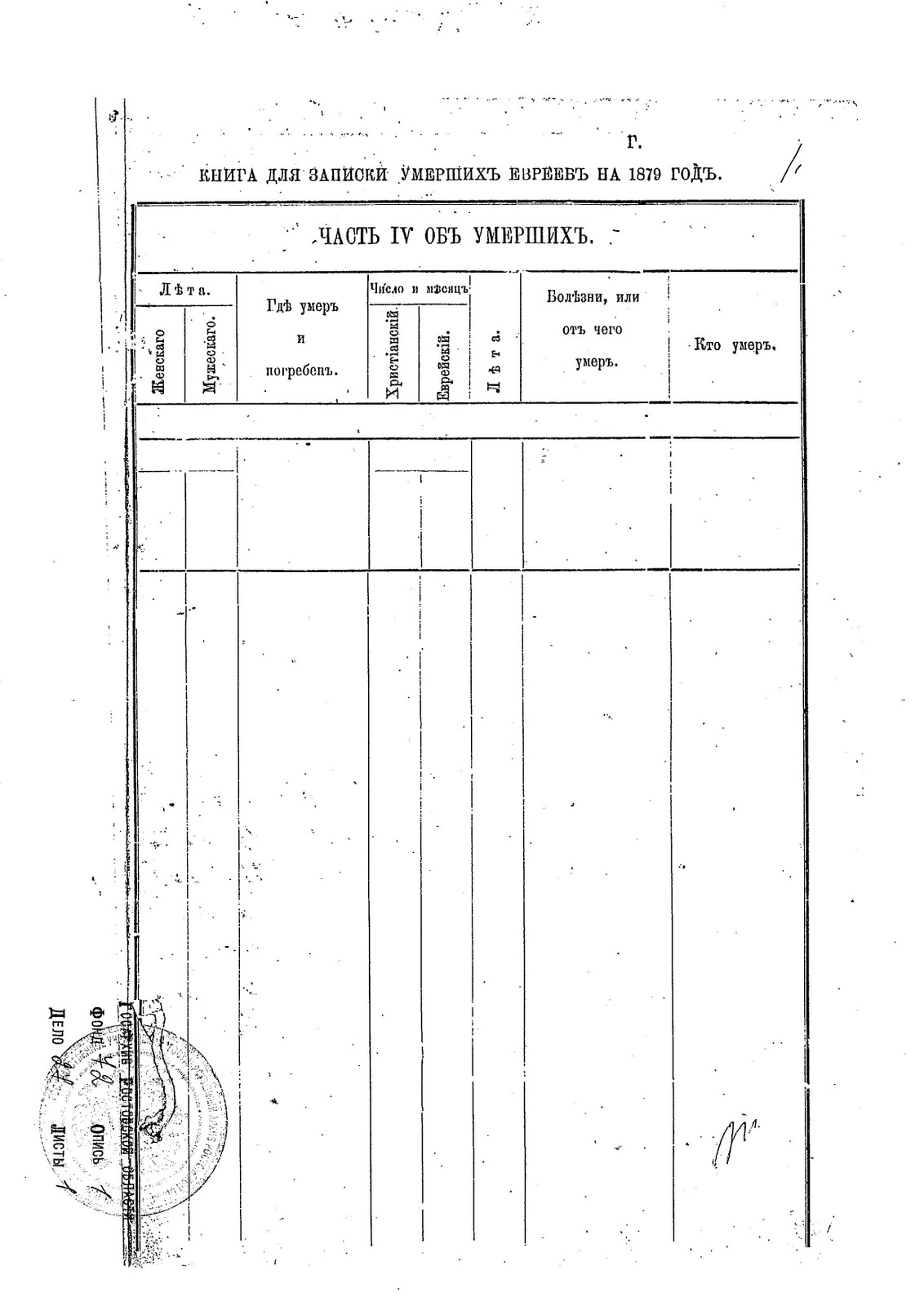
Tanya and I had hoped to find a good number of documents in Rostov, including their address, synagogue membership, a record of the tavern that Shlomo-Aron and Sophie ran—and perhaps something to authenticate the story of Rose having been kidnapped by Cossacks as a child. However the first class genealogist we took on, who worked with us for two days, Yevgeny Gimodudinov found only the two documents seen here, which show in reverse chronological order, the death of Shlomo-Aron and Sophie’s son Isai in 1879 and the birth of another son Gavrill (Gavriel) in 1878.

Somehow, we forgot to put these precious records up on the blog, so are doing it only now. Sorry, everyone. See directly below the English translation of these records done by my life partner and wonderful translator Tanya:
In the Rostov-on-Don metric book of vital records, which listed deceased Jews of 1879, there is a record #41 about the death that occurred on 8/13/1879.

The son of Rechitza Meschanin, Isai Solim-Aronovich Tulbovich, 3 years and 5 months, died of scarlet fever.

Search data: GARO; fund 72; list 1, case 27, Pages 19 - 20.


In the Rostov-on-Don metric book of vital records of 1878, there is a record #100 about the birth of the son Gavriil on 9/28/1878.

Parents: Rezhitsa Meschanin (Vitebsk Gubernia) Solim-Aron Peysakhovich Tulbovich and his wife Sifra-Ita Meerovna.

Search data: GARO; fund 72; list 2; case 14; Page 54.
If one reads my postings from Rostov at the time and then the follow-up postings in the ensuing few months (under Tulbowitzes of Rostov-on-Don, Tulbowitzes of Rezhitsa), one shares the excitement we felt then over the following information gleaned from these two short accounts:

Shlomo-Aron and Sophie Tulbowitz were registered as meschaninee (a social classification that could be translated as ‘townspeople’) from Rezhitsa, a place we were eventually able to identify as being modern-day Rezenke in Latvia (a genealogist in Minsk Belarus, Maxim Mill was able to find records of Shlomo-Aron’s parents Peisach and Sora in the 1850 census in Rezhitsa, together with Shlomo-Aron himself then aged 5.)

So thanks to Gimodudinov’s discovery of these precious documents in the Rostov municipal records, we were able to determine that Shlomo-Aron and Sophie had moved nearly 1000 miles from the northern climes of Latvia to the southern plains of Rostov as a young couple (presumably around 1870 and then depart for the U.S. 20 years later). Until my trip with Tanya to Rostov, no one alive today had any idea where the family had lived before moving to Rostov, which was a late 19th Century boomtown, on the Don River near where it flowed into the Black Sea and a place to which a lot of people, including many Jews, came in search of economic opportunities and increased social mobility, outside the more constricting Pale of Settlement.

We can imagine the family's decision to leave for America about 20 years was greatly influenced by the growing anti-Semitism in the area, which was also the center of the Don Cossacks and had been made a Cossack military province in 1888 by order of the Czar. But first and foremost there was the salient fact (which came to us through family lore) that Abe was apparently in danger of being drafted into the Russian army, a fate he wanted desperately to avoid—and emigration may have been the only way out. They may also have left in search of increased economic opportunity, although they were likely making a better living with the tavern than most poverty-stricken Russian Jews.

Certainly, their meschanin status and other indications that come down to us through family lore give the impression that the family was not without means or upward mobility. Sandy Brenner, our father Stan’s cousin, and the only member of the family who knew Rose who is still with us today, remembers that her grandmother Rose used to tell her proudly that Rostov was the most beautiful city in the world. Also, Rose was said to have preferred speaking Russian, not Yiddish, an indication that as a young girl she wanted to be part of the world of high Russian culture, of Tolstoy and Dostoyevski, and not the shtetl world of Shalom Aleichem. Of course, when she and her husband arrived in the Lower East Side of New York in 1890, Rose saw a real shtetl world and was deeply unhappy, leading Abe, Sophie and Rose to pick up stakes and move to the more all-American, less overtly Jewish environment of Albany, even before Shlomo-Aron and Eduard come over. (We are not sure what happened to Gavriel.)

But to bring this story up to date, several days ago we received startling news via Dan Ruby, who, unlike me, actually peruses Ancestry.com, Jewishgen and the other sites. Here is what Dan found:

This just popped up in my email. It looks promising for Abe, Rose and Sophie's ship manifest, which we've been missing. It shows that they sailed aboard the Esperanza from Hamburg on July 2, 1890, bound for New York via Liverpool. Among the passengers are Schifre (age 42), Abram (20) and Rosa (18) Rattner.

Surprises, if this is them: Their previous residence is listed as Czerkask, not Rostov. Also, they are already using the name of Ratner before their arrival in New York.

- Dan
In subsequent postings Dan finds other records which show that the Esperanza took them only from Hamburg to Hull (near Liverpool in England), from which they sailed to New York two weeks later aboard the ship Teutonic, from Liverpool to New York. Dan, can you put that stuff up on the blog as well?

So Dan’s find brought us not only the exact story of the Tulbowitzes voyage to America—from Hamburg, not Bremen, Germany as had come down to us, with no previous mention of the stopover in England, with some strange added details, such as Schifre being identified as a citizen of Finland, which was then a province of the Russian Empire, not an independent country. It shows that they chose the name ‘Ratner’ for reasons unknown even before they arrived in America; not that it was given to them by a U.S. immigration official at Ellis Island, as we had believed earlier.

Why Abe would have changed his family name from Bloch to Ratner is not known to us, but given that he was of military age and desperate to avoid being conscripted, securing fake documents with a different family name even before he left Russia made eminent sense (According to family lore he crossed the border on a wagon under a haystack, whereas Rose and Sophie came out in normal fashion and met up with him once they were all out). In fact, I knew a fellow in 1990 in Moscow who secured false papers and hid out in his dacha to avoid being taken into the army so such behavior still happens today.

The document unearthed via Ancestry.com also lists the emigrants' hometown not as Rostov as we had always believed, but ‘Cherkassk’ which likely referred to one of two smaller towns close to Rostov; Starycherkassk (Old Cherkassk) or Novocherkassk (New Cherkassk). It happens that I have visited both places, the first in 1992, on my first visit to Rostov to report on the resurgence of the Don Cossack movement in the region in the wake of the demise of the Soviet Union, and the second in 1999 when I was doing some similar reporting. Starycherkassk is a tiny, largely agricultural, stanitza or Cossack village—and so seems unlikely to have been the home of any Jews, including during the late 19th century when anti-Semitism was at its peak.

But Novocherkassk, which was founded in 1805 and is located maybe 30 miles north of Rostov, was, then as now, a larger and more cosmopolitan place, with a large Cossack population, but with a mainstream Russian majority and quite a few Jews, most of whom were rapidly emigrating to Israel and America (that was true in the 1890s as well as the 1990s). For more on Novocherkassk, see the Wikipedia article.

When I visited in 1999, I hung out with Anatoly Iasenik, a fearless Jewish activist and newspaper editor who had built personal and communal ties to a particular local Cossack ataman (leader) who was friendly to the Jews (several of the ataman's competitors had renewed longstanding Cossack anti-Semitism). Several years later Anatoly, whose own life was threatened by powerful business interests whose corruption he had exposed in his newspaper) fled to America and found me by complete accident when he met with Tanya, who then worked at NYANA, a not for profit agency that helped resettle arriving Russian Jews. Anatoly showed her my picture as someone he wanted to locate, and the amazed Tanya said, ‘That’s my significant other.’ When I met Anatoly, he informed me that the ‘good’ Cossack leader he had taken me to meet was later murdered by his rivals.

So Novocherkask was a dicey place in 1999, just as it had been 110 years earlier when Rose (who according to family lore had been kidnapped and held for ransom by Cossacks as a young girl—as an adult she would show family members scars on her legs from an incident when she was accidentally burned by hot water from a samovar during her captivity), Abraham and Sophie presumably left the place and began their ‘honeymoon’ escape to America.

So the historical parallels are compelling and not a little chilling and ESPish, and I feel privileged to have been able to go back there a century later and gain some inkling of the life they must have had then. (I guess that is the book I need to write before too long).

But in any case, if the Tulbowitzes lived in Novocherkassk instead of Rostov, that would explain the dearth of records concerning them in the Rostov archives. Likely they came to Rostov (the capital of the province) for Sophie to give birth to Gavriel in 1878 in a decent hospital, and maybe came back a year later to try in vain to save the life of Isai. That would explain why those two mentions of the Tulbowitzes are found in the Rostov municipal records today, but no other mention of the family, which was presumably living and running their tavern in Novocherkassk. Tanya and I are now going to re-contact Gimodudinov, the Rostov archivist to see if he can go to Novocherkassk to check the records there for mentions of the Tulbowitz family.

But why would Rose have left her grandchildren Stan, Sandy and their descendants with the impression that she came from Rostov, “the most beautiful city in the world”, rather than the decidedly less renowned and glamorous Novocherkassk 30 miles away? Probably for exactly that reason. In Russia, even today, there is a phobia about being ‘from the village’, or ‘from the sticks’ and thereby be seen as a ‘peasant’. Tanya, who was born and raised in the provincial town of Shostka, Ukraine, 300 miles northeast of Kiev, used to tell Americans who would ask where she was from that she hailed from Kiev (where she went to college and subsequently as a young adult) without mentioning Shostka, a rather rough and tumble, working class place about which she had decidedly mixed feelings.

Tanya points out that if she mentions ‘Kiev’ to Americans, they would have heard of it and be able to relate to her origins, but would not have heard of Shostka. But it is also the case that Tanya left Shostka at 18 for Kiev and a better (more cosmopolitan) life, and didn’t necessarily want others to know from whence she came. It seems to me likely that Rose might have been animated by the same way of thinking.

In the meantime, thanks to Dan, we are much closer to figuring out the ‘Tulbowitzes in Rostov (province) story”. We’ll post the news of Gimodudiov’s search of the Novcherkassk records as soon as we have them.

Friday, July 04, 2008

Meet Rezekne expert Dave Howard


In my researches into the Tulbowitz family, I came across the well-documented work by Dave Howard, a descendant of the Gurwitz family of Rezekne who has done a great deal to discover and publish information on our ancestral town. The photo shows Dave on one of the residential streets in the old Jewish part of Rezekne.

We've been in touch several times in the last few weeks, with the result that he plans to include our Tulbowitz information in the JewishGen ShtetLink for Rezekne that he is currently compiling. Until that is ready, here is Dave's Rezekne page on his FamRoots.org site. Much of what we will see when we visit Latvia next year is already available for view on these pages. Thanks, Dave.

Friday, June 20, 2008

Katz name derivation

Oh boy, I have a lot to catch up on here. I visited the Mormon Family Research Center in Oakland, where I met Jeremy Frankel, the president of the SF Bay Area Jewish Genealogical Society. More on that, and what I learned about ordering LDS records, in an upcoming post.

Also, I connected online with Dave Howard, who is the leading researching about the Jewish community in Rezekne. His FamRoots.org and HorwitzFam.org sites are a treasure trove of information. I will be posting highlights and links to the most relevant stuff in an upcoming post.

For now, I thought I would post this excerpt from Alexander Beider's Dictionary of Jewish Surnames From the Russian Empire. Howard has a few small parts of the work available to view on his Horwitz site. Here is a section dealing with the surname Katz.


Since it is hard to read, I will summarize. Katz originates from the name Kohen, which means priest in Hebrew, possibly the same as Goan. Kats or Katz is an acronym for Kohen Tsadek (Kohen of righteousness). The name was common throughout the Russian Empire. Of course, our great-grandmother was Bette Katz, the wife of Julius Wolgemuth of Koenigsberg.

By the way, Beider has another volume on Jewish surnames in Galicia, which are likely to contain informative entries for Ringel and Kaufler. The books are published by Avotainu and are very expensive. I will be looking for where I can find them in a library.

Monday, June 02, 2008

Rezekne Family List turns up trove of Tulbowitz kin

Walt, I just looked again at the 1900 U.S. census record for Solomon and Sophie (and Edward) Tulbowitz, and noticed a couple of interesting things. First, the census includes information for "Mother of how many children" and "Number of those children still living." In Sophie's record, the responses are 5 and 3. Second, Solomon and Sophie are both listed as having been married 34 years.

That's a lot of years. Since they were 52 and 49, respectively, at the time of the census, they would have been 18 and 15 at the time of their marriage. I don't remember what we know of exactly when and why they left Rezhitsa. Can you remind me?

On the number of children, I have Rose, Gavriel, Edward and Yitzhak (who died young). That's four, not five. I'm not sure where my information is from, but I have both Gavriel and Edward with a birthday in September 1876. Were they twins? Also, little Yitzhak (Isai) is 3 years, 5 months at the time of his death in August 1879, which does not compute. There are some mysteries there.

Twyla got me started on this today trying to talk up a trip to the Baltics in September. Intriguing idea. She'll have been in Finland with Kate, so maybe I would meet her in Riga and try to take in a circle from Rezhitsa to Kovno to Königsberg.

Anyway, that's what got me looking up Rezekne information today and I surprised myself with what I turned up. I'm not sure why I hadn't found the Tulbowitz stuff before. I guess because I hadn't searched the Latvian SIG. By the way, the info that came from Maxim on Tulbowitz in the all Russia census is also in Jewish Gen, but I have a hard time matching those names with the ones from the Rezekne Family List that I sent earlier.

My working theory is that our ancestor Sholom Ahron Tulbowitz' father Gavriel had a brother Leiba. The two brothers had sizable families that accounted for most but not necessarily all the Tulbowitz population of Rezhitsa.

On Gavriel's side, there were four sons (information is less available about daughters)-- Peisach, Salman, Eliasch (the eldest) and Abram. Peisach married Sara (not Sora?) and had Sholom Ahron, apparently an only child or at least only son. (From there, in our direct lineage, Sholom Ahron married Schifra Ita, also known as Sophie and later Bubbie, and they had Rose Ratner nee Tulbowitz as the first of their five children.)

Piesach's three brothers produced a total of five other sons and at least five grandchildren. Thanks to the Rezekne Family List, I have complete birth dates and spouse names for all of them. Same for Leiba's three sons and their offspring. One reason that branch is interesting is that two of the names Manzik (or possibly Manzin) Tulbowitz (son of Mowscha son of Leiba) and his wife Beila are also on another list of people in Riga with travel documents in 1900.

So that establishes that other Tulbowitz relatives of ours made the journey to America, and presumably accounts for the number of Tulbowitz sightings in places like Bayonne NJ and Wilmington DE. Not all came to the U.S.--a Sergio Tulbowitz is a musician and Marcelo Tulbowitz a professor, both in Montevideo.

The Jewish history of Rezekne is pretty well documented and memorialized, and there is an archivist who seems to be the major expert. He also does videos about Jewish historical subjects. Here is the catalog.

Saturday, December 29, 2007

The younger generation moved to Rostov, but the elder Tulbowitzes stayed in Latvia

More 120 year old news about the Tulbowitz clan from the Minsk archives sent to me today by archivist extrordinaire Maxim Mill:

Hello Walter,
I have looked at the 1886 list of Vitebsk guberniya business owners (it has preserved only partially) and found following record:
"Peisach son of Gavriel Tulbowitz 68 years old listed with Rezhitza Jewish Community small retailer."
It means that Solomon's father continue living in Rezhitza after his son moved to Rostov.
Exact dates of birth of Tulbowitz family members we will not be able to determine, only their year (that's how records used to be taken)
The earliest Rezhitsa records I've seen in the archive are in the bad condition and go as far back as 1806.


I can imagine the reproachful letters from Peisach and Sora to Shalom-Aron and Sophie:
It was bad enough when you got the meshuganah idea to abandon us to move to far-off Rostov--to go live among the Cossacks. Nu, that came out really well, didn't it? But now in our declining years, you decide to move to the end of the world...to America. Pure madness! But maybe you can take us along with you? No, you dont need to be weighed down by alterkakas (old folks)...But it breaks our hearts we will probably never see you again...But still, you are right, get the kinderlach out of Russia before the next pogrom...May God protect you on your long journey...

Something like that. Sunrise, sunset and all the rest...

Wednesday, December 26, 2007

Big News! Proof that Tulbowitz family of Rostov originated in Rezhitsa, Latvia


Please read the back and forth between myself and geneology investigator Maxim Mill who has been looking into the roots of the Tulbowitz family who were identified to Tanya and I during our trip to Rostov as "Rezhitsa meshanye (small merchants from Rezhitsa).

On 12/24/07, Belarus wrote:
Dear Walter,

I have checked Rechitsa and Rezhitsa beginning and mid of 19th century records.
In Rechitsa there is not even close to Tulbowitz last name was found.
In 1811 Rezhitsa revision list just one family with this last name was found, in 1850 lists 2 Tulbowitz families were found.
Minsk historical archive only has Rezhitsa records prior to 1858 year. The latest records are being kept in Riga (Latvia) historical archive.

Regards,
Maxim

Walter Ruby wrote:
Maxim,

First, many thanks for your efforts and for clarifying that there are records of Tulbowitzes from Rezhitsa, but not in Rechitsa. We are very excited to hear that you located some Tulbowitzes in Rezhitsa at exactly the right point in history (the first half of the 19th Century). First, can you explain to us exactly where Rezhitsa is today? Is it in Russia or Belarus? I understand it is near Vitebsk, but I have been unsuccessful in finding it on the map. What is the population today and what would have the approximate population been in 1850? Was it a mainly Jewish town in those days? Did it have any distinctive features? I see on the Internet that there is also a Rezhitsa (now called Rezekne) in Latvia. Could our Tulbowitzes have been from there as opposed to the Rezhitsa near Vitebsk?

We are obviously most interested in the first names of people in the Tulbowitz families from Rezhitsa that you found both from 1811 and 1850. As I believe I informed you previously, we know that Solomon Tulbowitz (1845-1918) (my great-great grandfather) and his wife Sophie (1846-1928) moved to Rostov-on-Don and are listed in records there from the 1870's as "Rezhitskee Meshanye". We know from their gravestone in Albany, N.Y. that Solomon's father was named Pesach and Sophie's father was named Meir. Do any of these names appear in your records? Do any other first names appear?

We understand from everything we have learned that the family name Tulbowitz was quite unusual. Do you have any idea of the origins of the name? Given that Solomon and Sophie are identified in the Rostov records as having been from Rezhitsa and given that you have found two Tulbowitz families from there in 1850, is it a safe deduction that we are descended from one of those families?

Please give my warm regards to Yuri Dorn and tell him I will be in touch with him shortly. Again all the members of the Ruby family all very much thank you for your efforts on our behalf.

Best Wishes and S'Novim Godum,


Walter Ruby


On 12/26/07, Belarus wrote:

Hello Walter,

Current name of Rezhitsa is Rezekne, which is in Latvia, not in Belarus. This town was renamed twice: in 1915 and in 1946. Today it's population is close to 38,000 residents.
In 1808 Rezhitsa's population was 754, from them 536 residents were Jewish. This place had only one street. In 1852 overall population was 3,615, from them Jewish population was 2,303.
Prior to 1939 there were 6 active synagogues, 2 Jewish schools, and 1 Talmud Tora.
In 1939 population was 10,795, from them 6,478 were Jews.

In 1850 Rezhitsa census there is a record:
Tulbowitch Peisach son of Gavriel, 32 years old
His wife Sora, daughter of Meir, 28 years old
Their son Sholom-Aharon, 5 years old

I only made this note, because I thought that it might be the perfect match.
I have forwarded your regards to Yuri, now he asked me to send you his.

Best regards,
Maxim


From: Walter Ruby < walterruby@gmail.com>
Date: Dec 26, 2007 8:34 PM
Subject: Re: Belarus research
To: Belarus


Maxim, Thats it--you are right. Its the perfect match. Shlomo was also Shalom-Aron; forgot to mention it in last e-mail. Is there any way of knowing when Shalom-Aron and wife Sophie moved to Rostov? Could their parents possibly have accompanied them? Also, how far back can we take the family? Do we have birth dates of Peisach and his father Gavriel or other family members? Anything on professions, military service, etc? We are enormously grateful for this information...

Best,

Walter Ruby

Walter Ruby to Dan, joanne, eruby
show details 8:36 pm (41 minutes ago)

Dan, Jo, Gene--check out message from Maxim below!!!! Pretty amazing stuff....


Amazing stuff indeed! We now know the town in Latvia from which the our great-great grandfather Shalom-Aron Tulbowitz and his wife Sophie set out for distant Rostov, probably in the late 1860's or early 1870's. We dont know if Peisach Tulbowitz or any of the older generation went with them as well, though we found no mention of them in the Rostoc records, as we did of Shalom-Aron, Sophie and two of their children, Gavriel (b. 1878), no doubt named for his great-grandfather, Gavriel, now our farthest back ancestor (great-great-great-great grandfather) and Isai (d 1879, aged 3). Why did young Shalom-Aron and Sophie move to Rostov...One would assume for the far greater economic opportunities; as we know Rostov was a booming port town and thus a good place to open a tavern. Byut why did they go so far and not to Riga, Kiev, Moscow, St. Petersburg? Well, the last two were clearly closed to Jews in 1870, and I am guessing that was true of Riga and Kiev as well, though need to confirm that, Odessa was likely open but nearly as far away as Rostov...I suspect Maxim and Yuri Dorn, the chief Jewish geneologist in Belarus, will be able to help us with some of this conjecture.

So here are Shalom-Aron and Sophie moving to Rostov full of hopes and ambitions around 187o and then pulling up stakes and follwoing their daughter daughter Raizl (Rose) and her new husband Abraham Bloch to America 20 years later. Why? Here we have some pretty strong conjecture that having had Rose kidnapped as a small girl and having to pay ransom to get her back and then having the province being placed in the hands of the Cossack military brigade in 1887 by order of the Czar, was more than the Tulbowitzs wanted to put up with--especially if you factor in a small pogrom in Rostov in 1883 begun after a drunken peasant refused to pay his bill to a Jewish innkeeper (if it wasnt the Tulbowitzes, it must have been someone they knew). So Sophie leaves Russia for America together with newlywed Rose and Abe in 1890 and then Shalom-Aron follows with another other child Eduard 3-4 years later--once Abe, Rose and Sophie--have moved up to Albany. (there was supposed to be another child of Shalom-Aron and Sophie alive in 1900 but we dont have a record of him/her? Could it have been Gavriel, born in 1878 in Rostov?

Anyway, what a life for Shalom-Aron and Sophie moving from one side of the Russian Empire to the other early in adulthood and then 20 years later pulling up stakes again and following their children to the Goldenye Medina, all the time searching for a place that they and their children could live in peace and security and have some prospects of economic success as well. We know they had already achieved a good bit of that in Rostov with the tavern, and Rose grew up as a modern girl who loved Russian culture and loved Rostov. It must have been a bitter pill when they deduced that all of that effort had been in vain and there simply was no safe future for Jews in Russia. As an old lady, Rose always told Sandy Brenner that Rostov was the most beautiful city in the world...Its strange for me too having made three trips to the city and having come to relate to Rostov as one of our ancestral lodestones to find out that the family was only there about 20 years (considerably less than I have lived in New York) and that the Tulbowitzes were really Litvaks whose hometown was only a couple of hundred miles away from the origins of the Spektor-Rabinowites in eastern Belarus and later Kovno (Kaunas), Lithuania. Lena Lincoff's--our great-grandmother on the other side of Dad's family--and Walter Ruby's mother presumably is descended from the town of Likuva in northern Lithuania, maybe 100 miles from Rezhitsa (Rezekne) in Latvia. And, of course, as we know, the roots of our mother Helga's family is nearby East Prussia and likely before that, the Minsk area of Belarus. So what we have is a whole lot of Litvaks from all the sides...

Wow a lot to assimilate but an enormous sense of exaltation to have taken the two families, Spektor-Rabinowitzes and Tulbowitzes, back several generations before what Stan was able to tell us about them before he died. We have brought to light much that had seemed completely obscured in the mists of time. A collective pat on the back to all of us and also to my partner, Tatyana, without whose formidable translation skills and acting as a wonderful resource to help me understand many of the cultural and historical facets of this, we would never have made the great progress we have...Next up, The Rubys: The Book.