Friday, September 17, 2010

Helga's ship manifest and special inquiry

Here are a couple of fascinating new documents also discovered via Ancestry's hinting feature. First is the passenger manifest of U.S. aliens arriving on the SS Guine in New York April 15, 1941, showing Elly and Helga Ringel and Herbert and Hilda Peiser among the passengers. The second is a record of those aliens held for special inquiry, showing those same four names.

Both documents include lots of annotations and data that I have not yet taken the time to fully interepret, but presumably tells the story of the group's initial stop in New York, where they were denied admission to the U.S., but where they gained the documentation that allowed them to enter later through Miami from Cuba. More analysis to come.


Another Seymour Rabinowitz?

Here's one that has had me puzzled for a while but I hadn't delved into it until mentioning it to Harriet on the phone the other day. We've always known of Julius Rabinowitz's two children Abner and Judith, but the family's census records show that there was also an older son Seymour. Now that is odd, one, because we have not heard of him and, two, because Julius had a living brother Seymour and one would have thought that precluded him giving his son the same name.

In the past, when I saw Seymour listed on the family's 1930 census, I thought that perhaps that was brother Seymour Rabinowitz who might have been boarding with them. However, the age is not right since this new Seymour seems to have been born in 1903. Also, there is another 1930 census record with Seymour the truant officer living alone. That Seymour, Harriet's father, was born in 1887.

I had left that alone, but now I see that the younger Seymour is also listed on the Julius Rabinowitz household in 1920, when the elder Seymour is still residing with Lena and a couple of other siblings.

The census pages are shown below. In both cases, only some of the family members are shown since they are on the top lines of the form and the missing family members are on the previous page. I have checked that they are there so you can take my word.

Anyway, from this, I feel we have to conclude that Julius and Anna Rabinowitz had a third child, actually their first, and they named him Seymour. And no he didn't die as an infant, as Harriet theorized, since he appears at age 27 in 1930. We'll have to search and see if we can find any other evidence of his life after that. Since the younger children changed their name to Robbins, perhaps Seymour did as well.


Wednesday, September 15, 2010

Meet Arthur Zimkin (and Rebe Eisenstein)


Readers of this blog know that we've been trying to track down all the lines of the Joseph and Lena Rabinowitz family to find any living relatives and learn what became of our various cousins. A big step ahead came when Harriett Berkowitz, the daughter of Seymour Rabinowitz, came forward. She provided fantastic new information, including her memories of her cousin Arthur Zimkin, who was the only child of Sadie Rabinowitz Zimkin, the oldest daughter of Joseph and Lena.

I was able to follow up on that with some Internet research and learned that Arthur had a son Mark, who lived in Toronto, where his mother Frieda Zimkin passed away in the late '70s. I covered that information in the blog.

Then early this year, I received an email from an Isolde Goldman of Hornell NY, who had read the blog and wanted me to know that she was a member of the Zimkin family and that her older cousin, a Rebe Colman Eisenstein of Hackensack NJ, knew Arthur well and would be willing to share information with me.

I contacted Rebe by mail and within days she reached me by telephone. I could immediately tell that, though elderly at age 90, she was sharp as a tack and full of memories about Arthur and other Rabinowitz family members. I said that I would be in New York in July and she invited me and Walter to come for a visit.


We did visit Rebe at her home in July (she the photo at left). She served us a lovely lunch and shared stories and photographs about Arthur Zimkin and his family, as well as of her own interesting history.

Arthur himself was a photographer, and the image topping this post is a self portrait.

I've delayed reporting on our fascinating meeting with Rebe because I have not yet fully reviewed the three-hour recording. I was not otherwise taking notes and I want to make sure that I get all of her revelations down accurately.

Now that I've posted this preliminary item, I will make it a point to listen to the tape and post the highlights as soon as possible.

Rattner ship manifests

Considering that both Walter and I had spent a good deal of time trying to find the records of our Ratner ancestors' passage to America, the story of how they finally came into our possession is somewhat anticlimactic. Ancestry.com now has a nifty feature of hints that automatically conducts searches and alerts users to information they may not yet have discovered.

Last week I received just such a hint for our great-grandfather Abraham Ratner pointing to an inter-European voyage from Hamburg to the Port of Hull near Liverpool. At first, I was inclined to disregard it: There were many Abram Ratners, and importantly we thought the Ratner name didn't come into use until Abe's arrival in America. Thus, a pre-arrival record for that name would not be him.

The 1890 date was the right year, however, and I clicked through to read more and view the actual document—the "directory" of passengers aboard the Esperanza sailing out of Hamburg on July 2, 1890. My excitement immediately grew as I saw the names of Abram's travel mates, listed as Schifre, age 42, and Rosa, 18. Abram was listed as 20. Exactly the right three names and ages for Abe, his bride Rose and mother-in-law Sophie. Here's the document (click to view close up):


At first, I thought the Esperanza sailed through to New York after a stop in England, but reading closer I realized that they disembarked at the Port of Hull and must have taken a different ship to New York. My quick reading about the Port of Hull supported that thought:
During the period 1836 - 1914, Hull developed a pivotal role in the movement of transmigrants via the UK. During this period over 2.2 million transmigrants passed through Hull en route to a new life in the US, Canada, South Africa and Australia. Originating from Denmark, Finland, Germany, Norway, Russia and Sweden, the transmigrants passed through the port, from where they would take a train to Glasgow, Liverpool, London or Southampton - the UK ports which offered steamship services to the 'New World' they had dreamed of.


On the document, New York is listed as "the aim of the emigration." But where was the record for the second leg of the journey? Easy. Now having the correct last name, the right month and year and departure port, another Ancestry search quickly came up with this passenger manifest for the July 16, 1890, sailing of the SS Teutonic.

Page 1 is included so you can see the cover information and column headings. Schrifre and Abraham Rattner appear about one-third of the way down on the second page, which is actually Page 3 of the manifest.


You'll see Sophie (Schifre) and Abe have the right ages. Oddly she is shown as a citizen of Finland, but that looks to be a random anomaly. More surprising is that Rose is not listed together with her family members. I've taken a quick scan of the rest of the manifest to see if she is listed elsewhere but didn't find her name.

So that remains as a loose end, but still we've made a big step forward in documenting our ancestors' journey to America, including finding an important clue to their previous lives that Walter follows up on in the next post.

Oh, here's a couple images of the Teutonic and a link to the Wikipedia article. She was a new state-of-the-art cruiser at the time of the voyage.


One last comment on why we hadn't found this information before. First, we weren't searching on Rattner. Second, the Esperanza record was not in any database we searched. Third, Ancestry's ongoing acquisitions in its international collections has exposed more existing records to its excellent search technologies. I'm pretty sure that Teutonic manifest must have been discoverable all along but we had missed it because the tools were not as good then as they are now.

Did the Ratner/Tulbowitz family really come from Novocherkassk?


Here is a belated posting, with historical records that should have been placed on the blog three years ago, but that is relevant again following Dan's discovery of the Rattner passenger lists.

Just over three years ago, Tanya and I went to Rostov-on-Don to look for records of the Tulbowitz clan, which we had known from family lore to have lived there prior to Raizl (Rose) (the daughter of Shlomo-Aron and Sifra (Sophie) Tulbowitz) and her new husband Abe Bloch heading out to America in 1890 with Sophie. Shlomo-Aron and their son Eduard follow several years later and the family ended up in Albany.

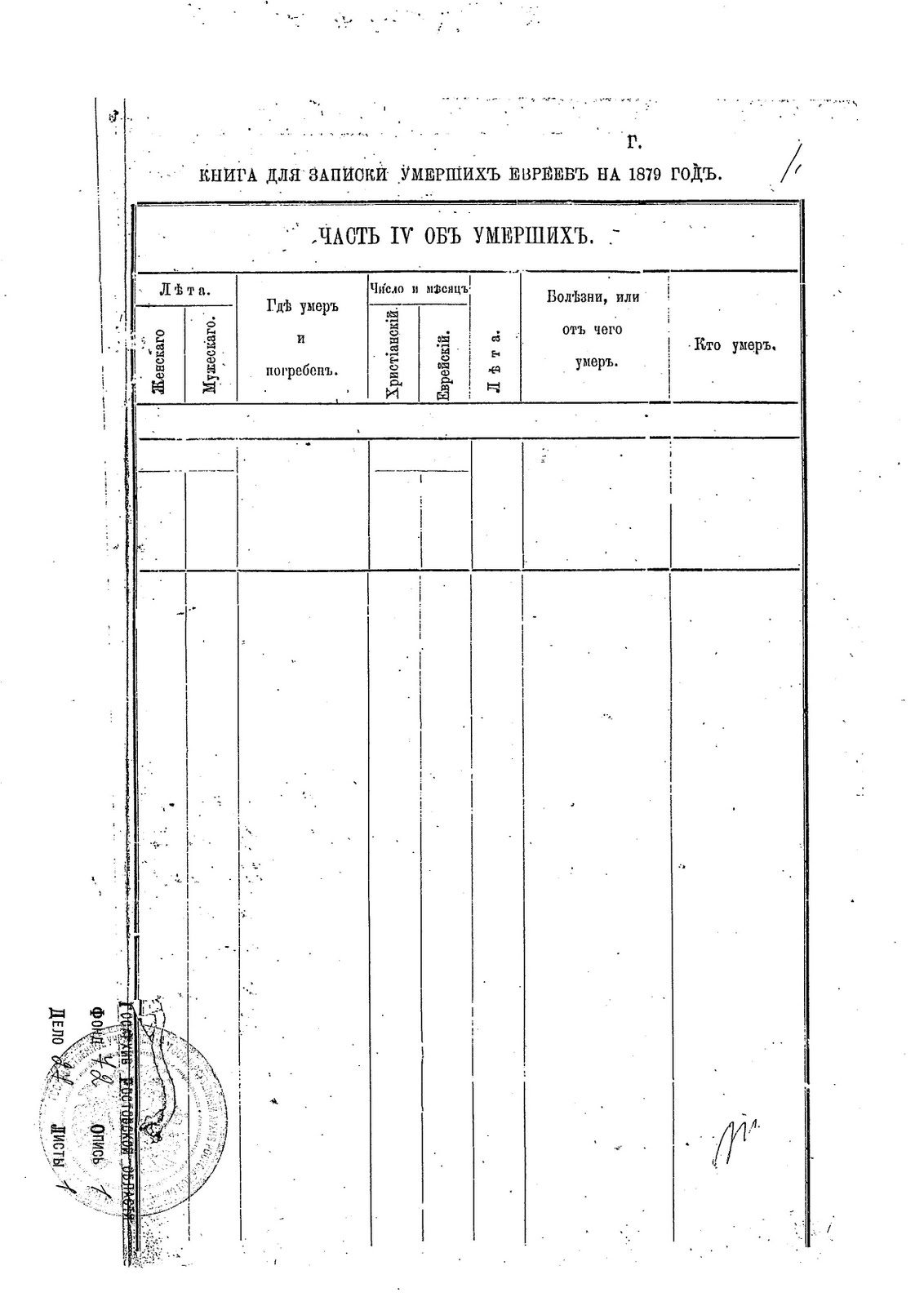
Tanya and I had hoped to find a good number of documents in Rostov, including their address, synagogue membership, a record of the tavern that Shlomo-Aron and Sophie ran—and perhaps something to authenticate the story of Rose having been kidnapped by Cossacks as a child. However the first class genealogist we took on, who worked with us for two days, Yevgeny Gimodudinov found only the two documents seen here, which show in reverse chronological order, the death of Shlomo-Aron and Sophie’s son Isai in 1879 and the birth of another son Gavrill (Gavriel) in 1878.

Somehow, we forgot to put these precious records up on the blog, so are doing it only now. Sorry, everyone. See directly below the English translation of these records done by my life partner and wonderful translator Tanya:
In the Rostov-on-Don metric book of vital records, which listed deceased Jews of 1879, there is a record #41 about the death that occurred on 8/13/1879.

The son of Rechitza Meschanin, Isai Solim-Aronovich Tulbovich, 3 years and 5 months, died of scarlet fever.

Search data: GARO; fund 72; list 1, case 27, Pages 19 - 20.


In the Rostov-on-Don metric book of vital records of 1878, there is a record #100 about the birth of the son Gavriil on 9/28/1878.

Parents: Rezhitsa Meschanin (Vitebsk Gubernia) Solim-Aron Peysakhovich Tulbovich and his wife Sifra-Ita Meerovna.

Search data: GARO; fund 72; list 2; case 14; Page 54.
If one reads my postings from Rostov at the time and then the follow-up postings in the ensuing few months (under Tulbowitzes of Rostov-on-Don, Tulbowitzes of Rezhitsa), one shares the excitement we felt then over the following information gleaned from these two short accounts:

Shlomo-Aron and Sophie Tulbowitz were registered as meschaninee (a social classification that could be translated as ‘townspeople’) from Rezhitsa, a place we were eventually able to identify as being modern-day Rezenke in Latvia (a genealogist in Minsk Belarus, Maxim Mill was able to find records of Shlomo-Aron’s parents Peisach and Sora in the 1850 census in Rezhitsa, together with Shlomo-Aron himself then aged 5.)

So thanks to Gimodudinov’s discovery of these precious documents in the Rostov municipal records, we were able to determine that Shlomo-Aron and Sophie had moved nearly 1000 miles from the northern climes of Latvia to the southern plains of Rostov as a young couple (presumably around 1870 and then depart for the U.S. 20 years later). Until my trip with Tanya to Rostov, no one alive today had any idea where the family had lived before moving to Rostov, which was a late 19th Century boomtown, on the Don River near where it flowed into the Black Sea and a place to which a lot of people, including many Jews, came in search of economic opportunities and increased social mobility, outside the more constricting Pale of Settlement.

We can imagine the family's decision to leave for America about 20 years was greatly influenced by the growing anti-Semitism in the area, which was also the center of the Don Cossacks and had been made a Cossack military province in 1888 by order of the Czar. But first and foremost there was the salient fact (which came to us through family lore) that Abe was apparently in danger of being drafted into the Russian army, a fate he wanted desperately to avoid—and emigration may have been the only way out. They may also have left in search of increased economic opportunity, although they were likely making a better living with the tavern than most poverty-stricken Russian Jews.

Certainly, their meschanin status and other indications that come down to us through family lore give the impression that the family was not without means or upward mobility. Sandy Brenner, our father Stan’s cousin, and the only member of the family who knew Rose who is still with us today, remembers that her grandmother Rose used to tell her proudly that Rostov was the most beautiful city in the world. Also, Rose was said to have preferred speaking Russian, not Yiddish, an indication that as a young girl she wanted to be part of the world of high Russian culture, of Tolstoy and Dostoyevski, and not the shtetl world of Shalom Aleichem. Of course, when she and her husband arrived in the Lower East Side of New York in 1890, Rose saw a real shtetl world and was deeply unhappy, leading Abe, Sophie and Rose to pick up stakes and move to the more all-American, less overtly Jewish environment of Albany, even before Shlomo-Aron and Eduard come over. (We are not sure what happened to Gavriel.)

But to bring this story up to date, several days ago we received startling news via Dan Ruby, who, unlike me, actually peruses Ancestry.com, Jewishgen and the other sites. Here is what Dan found:

This just popped up in my email. It looks promising for Abe, Rose and Sophie's ship manifest, which we've been missing. It shows that they sailed aboard the Esperanza from Hamburg on July 2, 1890, bound for New York via Liverpool. Among the passengers are Schifre (age 42), Abram (20) and Rosa (18) Rattner.

Surprises, if this is them: Their previous residence is listed as Czerkask, not Rostov. Also, they are already using the name of Ratner before their arrival in New York.

- Dan
In subsequent postings Dan finds other records which show that the Esperanza took them only from Hamburg to Hull (near Liverpool in England), from which they sailed to New York two weeks later aboard the ship Teutonic, from Liverpool to New York. Dan, can you put that stuff up on the blog as well?

So Dan’s find brought us not only the exact story of the Tulbowitzes voyage to America—from Hamburg, not Bremen, Germany as had come down to us, with no previous mention of the stopover in England, with some strange added details, such as Schifre being identified as a citizen of Finland, which was then a province of the Russian Empire, not an independent country. It shows that they chose the name ‘Ratner’ for reasons unknown even before they arrived in America; not that it was given to them by a U.S. immigration official at Ellis Island, as we had believed earlier.

Why Abe would have changed his family name from Bloch to Ratner is not known to us, but given that he was of military age and desperate to avoid being conscripted, securing fake documents with a different family name even before he left Russia made eminent sense (According to family lore he crossed the border on a wagon under a haystack, whereas Rose and Sophie came out in normal fashion and met up with him once they were all out). In fact, I knew a fellow in 1990 in Moscow who secured false papers and hid out in his dacha to avoid being taken into the army so such behavior still happens today.

The document unearthed via Ancestry.com also lists the emigrants' hometown not as Rostov as we had always believed, but ‘Cherkassk’ which likely referred to one of two smaller towns close to Rostov; Starycherkassk (Old Cherkassk) or Novocherkassk (New Cherkassk). It happens that I have visited both places, the first in 1992, on my first visit to Rostov to report on the resurgence of the Don Cossack movement in the region in the wake of the demise of the Soviet Union, and the second in 1999 when I was doing some similar reporting. Starycherkassk is a tiny, largely agricultural, stanitza or Cossack village—and so seems unlikely to have been the home of any Jews, including during the late 19th century when anti-Semitism was at its peak.

But Novocherkassk, which was founded in 1805 and is located maybe 30 miles north of Rostov, was, then as now, a larger and more cosmopolitan place, with a large Cossack population, but with a mainstream Russian majority and quite a few Jews, most of whom were rapidly emigrating to Israel and America (that was true in the 1890s as well as the 1990s). For more on Novocherkassk, see the Wikipedia article.

When I visited in 1999, I hung out with Anatoly Iasenik, a fearless Jewish activist and newspaper editor who had built personal and communal ties to a particular local Cossack ataman (leader) who was friendly to the Jews (several of the ataman's competitors had renewed longstanding Cossack anti-Semitism). Several years later Anatoly, whose own life was threatened by powerful business interests whose corruption he had exposed in his newspaper) fled to America and found me by complete accident when he met with Tanya, who then worked at NYANA, a not for profit agency that helped resettle arriving Russian Jews. Anatoly showed her my picture as someone he wanted to locate, and the amazed Tanya said, ‘That’s my significant other.’ When I met Anatoly, he informed me that the ‘good’ Cossack leader he had taken me to meet was later murdered by his rivals.

So Novocherkask was a dicey place in 1999, just as it had been 110 years earlier when Rose (who according to family lore had been kidnapped and held for ransom by Cossacks as a young girl—as an adult she would show family members scars on her legs from an incident when she was accidentally burned by hot water from a samovar during her captivity), Abraham and Sophie presumably left the place and began their ‘honeymoon’ escape to America.

So the historical parallels are compelling and not a little chilling and ESPish, and I feel privileged to have been able to go back there a century later and gain some inkling of the life they must have had then. (I guess that is the book I need to write before too long).

But in any case, if the Tulbowitzes lived in Novocherkassk instead of Rostov, that would explain the dearth of records concerning them in the Rostov archives. Likely they came to Rostov (the capital of the province) for Sophie to give birth to Gavriel in 1878 in a decent hospital, and maybe came back a year later to try in vain to save the life of Isai. That would explain why those two mentions of the Tulbowitzes are found in the Rostov municipal records today, but no other mention of the family, which was presumably living and running their tavern in Novocherkassk. Tanya and I are now going to re-contact Gimodudinov, the Rostov archivist to see if he can go to Novocherkassk to check the records there for mentions of the Tulbowitz family.

But why would Rose have left her grandchildren Stan, Sandy and their descendants with the impression that she came from Rostov, “the most beautiful city in the world”, rather than the decidedly less renowned and glamorous Novocherkassk 30 miles away? Probably for exactly that reason. In Russia, even today, there is a phobia about being ‘from the village’, or ‘from the sticks’ and thereby be seen as a ‘peasant’. Tanya, who was born and raised in the provincial town of Shostka, Ukraine, 300 miles northeast of Kiev, used to tell Americans who would ask where she was from that she hailed from Kiev (where she went to college and subsequently as a young adult) without mentioning Shostka, a rather rough and tumble, working class place about which she had decidedly mixed feelings.

Tanya points out that if she mentions ‘Kiev’ to Americans, they would have heard of it and be able to relate to her origins, but would not have heard of Shostka. But it is also the case that Tanya left Shostka at 18 for Kiev and a better (more cosmopolitan) life, and didn’t necessarily want others to know from whence she came. It seems to me likely that Rose might have been animated by the same way of thinking.

In the meantime, thanks to Dan, we are much closer to figuring out the ‘Tulbowitzes in Rostov (province) story”. We’ll post the news of Gimodudiov’s search of the Novcherkassk records as soon as we have them.

Saturday, October 31, 2009

New Ratner family branch discovered

New information (for us) about a branch of our Ratner family popped up on Ancestry.com, and as a result I have now made a connection with a new second cousin once removed. She is Nicole Richner, a great granddaughter of George Peyser Ratner, the older brother of our grandmother Selma.

We had known about Peyser's daughter Marjorie Decker, and knew that she had been alive in a nursing home near Albany until recently. Walter made an unsuccessful attempt to contact her. We also knew Marjorie had married Robert Ken Decker and that they had two sons, and thus we had conjectured that there could be another generation of Deckers. However, my efforts to discover who and where they were had gone unrewarded.

Then a week ago I am scanning Ancestry for new leads on the Rabinowitz side when I am presented with alerts that new information has been posted about people in my family tree. Clicking through, I see that George Pizer Ratner is a part of a new Decker Family tree that was posted on October 3 by an Ancester member named Nicole Richner. Attached to his record are several familiar census citations that confirmed that this was the same George Ratner that is our great uncle.

Clicking further into the tree gave me several answers to open questions. First, Marjorie passed away at age 91 a year ago, in October 2008. I'm sorry that our project began too late to have reached her when she was able to contribute her memories. (Nicole has her photo albums, though.) Second, we now knew what had become of Marjorie's sons Ronald and Curt.

Well, sort of. Ancestry has a policy of not showing full information about a living people in members' family trees. The tree's owner can allow access to other members to see the full names and personal information, but I was viewing Nicole's tree as an unprivileged user. So all I could see was profiles labeled "Living Decker" for each person. Still, I could deduce that one of the two sons was unmarried and childless and that the other had had six children, three sons and three daughters. Two of the daughters had last names other than Decker, including a Living Alexander and a Living Richner, who had presumably married and taken their husbands' names.

So this living Richner was obviously the Nicole Richner that posted the Decker Family tree. Delighted to have learned this information but wanting to be able to see the full information, I sent off a message to Nicole through Ancestry's Member Connect feature. I identified myself as her second cousin and told her a bit of our Ratner genealogy and asked her to reply.

Today her message came back. Here is an excerpt:

Most of what I have has been due to my grandmother, that you so kindly mentioned in your email. She was an awesome women! I had the opportunity a few years back when both my grandparents were still living to visit with them for a few days. I went specifically to just sit and listen. They were the ones that gave me the framework for every peice of information that I have. I very grateful that I was able to do that. She also sent me her photo albums and other documents that I have yet to fully go through. She had a memory like an elephant. I was amazed at the information that she was able to share.


I've written back again and hopefully soon will be able to get photos and other information about Marjorie's Ratner family. With all the progress we've made about our Rabinowitz family as a result of Harriet finding us, it is exciting that we are positioned to learn more about our Ratners now that Nicole has turned up.

Sunday, September 13, 2009

Graves of Joseph and Lena Rabinowitz

Here are photos of the gravestones of Joseph and Lena Rabinowitz at Mt. Zion Cemetery in Queens. Note that Joseph is identified in both Hebrew and English as "Yehuda Noah" and not Yosef, which raises the question as to why he has come down to us as Joseph. He is also identifed as the son of Abrhaham Yoel and Leah as the daughter of Abraham Yaakov.
I am still working on the Hebrew translation, especially of Joseph's grave, which is quite poetic with the first line saying something like "For these, we are weeping" and the third line something like "From my head fell the crown".
Lena's grave identifies her as "our dear mother" and something like a "woman of righteousness"--but let me get the full translation because I am missing some important stuff from both of them.
Gene and I were moved by the cramped setting with a factory smokestack looking over the old cemetery which is clearly a slightly earlier and decidedly less opulent setting than Mt. Hebron several miles east where Walter and Selma Ruby are buried. More as soon as I get full translations...

Saturday, August 29, 2009

David Zimkin lists Arthur J. Zimkin as next of kin

Ancestry has a host of records for David Zimkin, husband of our great aunt Sadie. We see census records for 1900 and 1910 as well as the 1920 and 1930 we already knew about; draft registration cards for both World War I and II; and his Social Security death index. He died in New York at age 80 in 1966. (Note that he was born in Riga and that there is lots of information available about Zimkins in Latvia, but I don't have time for that now.)

Here is his WWII draft registration. Notice that he lists his only son Arthur J. Zimkin as the "person who will always know your address." Why is this significant? Because it is the first confirmation of Arthur's middle initial, which further links him to that Montreal engagement.


Freida Zimkin died in Canada

We learned from Harriet that Sadie Rabinowitz's son Arthur Zimkin married a Frieda. We have an intriguing 1965 Canadian engagement announcement for Mark Raymond Zimkin, son of Arthur J. Zimkin of New York. Now from Ancestry, below is a Social Security death index for Frieda Zimkin indicating that she resided and received social security benefits in Canada.

(She was age 64 at death. Would she have been eligible for benefits? I looked it up. Eligibility for female workers and widows was extended to age 62 beginning in 1956-—for men in 1961.)

Could be that Mark settled with his wife Phyllis in her hometown of Montreal, and that later his mother Frieda came to live with them. Speculation of course. If true, we'd like to find out if Mark and/or Phyllis are living, and whether they had children.

Name: Frieda Zimkin
SSN: 057-01-5649
Last Residence: 953 (U.S. Consulate), Canada
Born: 31 Dec 1912
Last Benefit: 953 (U.S. Consulate), Canada
Died: Jul 1977
State (Year) SSN issued: New York (Before 1951)

Sharon family 1975

Joanne is in Israel this week visiting with younger generations of the Sharon family. Here is a selection of photos from her visits to Kibbutz Afeq in 1975 and 1985. We'll look forward to a new batch following her trip.

Love to all the Sharon descendants and family as they observe Pnina's shloshim at Afeq tomorrow. 


Monday, August 17, 2009

1965 engagement of Arthur Zimkin's son is announced in a Canadian Jewish newspaper

Unlike some other names that turn up huge numbers of search results, there are not a lot of Arthur Zimkins. The one we are interested in is the son of Sadie Rabinowitz Zimkin and her husband David. Speaking with Harriet Berkowitz over the weekend, she mentioned that Arthur was married to Frieda and that they may have had a child.

I had searched on Arthur before but when I did it again yesterday, this very interesting citation came up. It is the November 5, 1965 edition of The Canadian Jewish Review, in the section on births, deaths, marriages and engagements. Under the heading of Montreal Engagements we see this very interesting announcement:

Mr. and Mrs. Mac Schwartz, 1357 Van Horne Avenue, announce the engagement-of their daughter, Miss Phyllis Penny Schwartz, to Mark Raymond Zimkin, son of. Mr. and Mrs. Arthur J. Zimkin, of New York.
Here is the image (click to enlarge). Look for the Schwartz Zimkin notice in the second column from the right near the top. It isn't necessarily the right one, but the ages are about right and as I say there are not a lot of Arthur Zimkins. This gives us a hopeful lead toward tracking down another living Rabinowitz line.


Thoughts on the new revelations and a glorious day with Gene


Dan,

Bravo on all of your amazing research since we got the death records for Joseph Rabinowitz and Lena Lincoff Rabinowitz. I also very much would like Bertha Yesersky to be the sister-in-law of Rabbi Spektor, as it would tie things up nicely with a pink ribbon, but as the culprit who led us down the garden path with my Alex Haley moment in the Yeshiva University archives three years ago, just assuming that the Joseph Rabinowitz mentioned in the Shimoff book and Toldos Yitzhak as having been trained in the Tamlud and Jewish Codes by Isaac Elchanan Spektor, MUST by our Joseph, the grandson of the great rabbi, I will now play the role of skeptic who warns about making such conceptual leaps. In short, I've been burned once before and its a powerful lesson.

Still, as you say, there is the name Bertha Yesersky popping up as Joseph's mother, and we know Sara Raizel Yesersky was the wife YES married at the age of 13, so there must be a family connection there. I must say that even as it became more and more clear that our Joseph Rabinowitz was NOT after all, the son of Rabbi Chaim Rabbinowitz and the grandson of YES, I never lost my bedrock faith that we were descended from Rabbi Spektor in some manner, because Stan Ruby told me so on a number of occasions during my childhood and he obviously would not simply have made that up. Obviously that information came from his father, Walter Ruby, but the exact nature of the connection got a little muddled over the years. So to see the name 'Bertha Yasersky' on Jseph's death certificate is certainly very powerful and compelling.

I went with Gene to the Mt. Zion cemetery on Saturday to check out and photograph the graves of Joseph and Lena Rabinowitz, only to learn to my dismay that Jewish cemeteries in the U.S. are locked up on Shabbat. Then we popped over to Mt. Hebron to see if by chance that onje would be open and Gene could meet Walter Ruby and Selma Ruby, but of course it was locked as well. I had somehow understood that the cemeteries would be open, but the offices closed, but I had figured we could find the graves without their help as we had the row number etc. Most disappointing because I may now not get a chance to go until after returning from the second of two trips around Sept 7. Gene plans to go on his own before that, but he seems to have lost the battery of his camera, so may not be able to take photos.

He has gotten interested in the family history thing recently; as he has realized that he lives between two cemeteries in Queens; one holding the remains of his great-great grandparents and the other his great grandparents. He was asking me a lot of questions about who they were etc, and that gives me a great feeling about what we have managed to do over the past five years to preserve and unearth the memory (much of it previously lost) of these forgotten generations for our kids and generations to come. All of this is a profoundly spiritual experience for me as I approach 60. Also for next month, I will make a trip to Varick Street to look for the ship record of the arrival of the families of Joseph Rabinowitz and Lena Lincoff in New York.

After Gene and I struck out at the cemeteries, we drove around talking and ended up in Flushing, Queens, so I took him to see one of the forgotten pieces of New York history, a Quaker meeting house on Northern Boulevard built in Cape Cod style that goes back to the 1690's, and a site a few yeards away where the English Quaker settlers of Flushing (a Dutch name) in 1655 demanded religious liberty from Peter Stuyvesant, the leader of nearby New Amsterdam whose sovereingity extended well into Long Island and up the Hudson River to Albany. The plaque at the site makes the point that the origins of the First Amendment to the Constitution (at least the freedom of religion part) flow from that incident in Flushing. Its one of those examples of forgotten history that we pass a million times a day and are blissfully unaware of and I think it impacted Gene a bit. Flushing, long very Jewish, nowadays has become New York's largest Chinatown (and Koreatown and Japantown and a little distance away India, Pakistan and Afghantown and is a wonderful place to step out of prosaic American reality and be swept into an Asian one. After our excursion the two of us went to a Japanese/Korean restaurant and discussed Israel and the Palestinians for several hours. All in all a great day with my son, even if we did miss the great-greats.

Sunday, August 16, 2009

Meet the Yeserskys

Receipt of Joseph Rabinowitz's death certificate earlier this week provided near conclusive evidence that the simple story of our relation to the illustrious Rabbi Isaac Elchanon Spektor is false. To have been true, we needed Joseph's father to have been named Chaim or Aryeh but it was in fact Abraham.

However, Joseph's mother's name opened a new possibility for a close familial connection to the rabbi. She was named Bertha Yesersky. You can see the death certificate here. The thing that is interesting about that is that Isaac Spektor was married to a Sara Yesersky at the age of 13 in 1830, and thereafter lived with the Yesersky family in the town of Volkovisk for a period of six years.

You may recall that Spektor was raised by his rabbi father Israel Isser in the town of Ros', just a few miles north of Volkovisk. After his marriage to Sara, he came to study in Volkovisk under the eminent rabbi Benjamin Diskin. He lived on the largesse of his father in law Eliezer Yesersky for those six years until he took on his first rabbinical appointment in another nearby village, Izabellin.

Now let's suppose that Eliezer and his wife Bluma have more children than just Sara. Since Joseph Rabinowitz is born in 1855, his mother was probably born somewhere in the range 1820-1835. What if Bertha Yesersky is a daughter of Eliezer and Bluma and is born in 1825? Then should would be five years old at the time of her older sister's marriage, and she would spend the next six years of her life closely influenced by the young man who would become a great rabbi who is sort of her big brother.

Louis Isard note about Yesersky genealogy, circa 1958.

Interesting but it might be a stretch. To check it out, I start looking up Yesersky on JewishGen and Ancestry, and there is no shortage of good leads. Right away, I see that there are two people listed as Yesersky, or Yezersky, researchers, a Joan Sohn in Toronto and Jay Cohen in Silver Spring, Md. I emailed both of them introducing myself, and both replied within a few hours.

Since then in email exchanges with Joan and Jay, as well as with two others, Steven Director and Robert Isard, I have learned a great deal about the Yesersky family both in Volkovisk and nearby cities as well as in Philadephia, where most of them ended up when they came to America. I will try to summarize.

Several of the Yesersky family members have a similar theory to mine but with Miriam as Sara's sister. That could well be, but there is a further twist in their case because Miriam was later married to Shmuel, son of Rabbi Joseph Lieber. The odd thing is that Shmuel would take the Yesersky name as his own, which seems peculiar on first thought but is not completely outlandish.

Especially in this family, where name changing seems to be the norm. But let me cut to the chase. Shmuel and Miriam have at least three children. We know that one of them Solomon raised his family in the nearby village Swizloch while another Zvi Hirsh moved to the bigger regional city Grodno. Both brothers had sizable families and many of their descendants would end up in the Philadephia, as I said.

One branch of Philadelphia Yeserskys are the Kormans. Sam Korman is at right.

One such was Louis Isard, who was born as Louis Yesersky, the son of Hirsh, in Grodno in April 1880. How his name changed—his and many other relatives who also became Isards—is not well explained. But hold that thought.

In the late 1950s, Louis is recovering from a heart attack and receives a visit from an Israeli cousin Tsvi Jezerski. Previously Louis didn't like to share a lot of family lore, but Tsvi prevailed on him to set down on paper the fascinating details of his family history. That included a family tree and a remarkable story involving not one but two illustrious rabbis.

You can read Louis Isard's note for yourself, but I will run through the high points. Louis says that his grandfather Shmuel Yesersky is the son of Rabbi Joseph Eliezer Lieber, and that Lieber is the son of the very famous Rabbi Judah Low Edel of Slonim, a city only 30 miles from Volkovisk. Two generations older than Spektor, Edel was known as a great Torah scholar and was the author of an influential book of teachings and several Hebrew lexicons. Here is his biography in the Jewish Encyclopedia.

Louis writes that Edel's grandson Shmuel becomes the husband of Miriam Yesersky, who he describes as the sister of Isaac Elchanon Spektor. He also writes that one of his uncles, Leib Yesersky, was among the founders of the Isaac Elchanon yeshiva in New York in the late 1890s.

The note seems to have a few things mixed up, but mainly it checks out with known facts. We know that both Miriam Yesersky and Sara Yesersky are from Volkovisk (which by the way we don't know about Bertha). If she is a sister, she would be Spektor's sister-in-law, and would have grown up with him in the household. The fact that her son Leib goes to America and is a follower of Spektor there suggests the great influence that Isaac had on the family.

Solomon Yesersky's final resting place at Montefiore Cemetery in Jenkintown PA

So I am inclined to accept Louis' story at pretty much face value, despite all the peculiar name changing. Now the question becomes can we connect our Bertha Yesersky with the Yeserskys of Volkovisk. So far there is no hard evidence but there is one tantalizing tidbit.

The note-writing Louis Yesersky Isard had a sister name Bertha Yesersky who born in 1878. If our Bertha born around 1825 was a sister of Sara Yesersky, and Miriam was also a sister, then the older Bertha is the great aunt of the younger one. With the Jewish prohibition on naming for living relatives, the older Bertha must have passed away before 1878. Maybe her passing was the cause for that naming.

So I was going to quit on that point, but I just came across an oversight in my work. Almost a year ago, I was contacted by Shirley Portnoy for help on something related to Rabbi Spektor. Unfortunately, I was just then going into the hiatus in my research from which I am now emerging, and I fear that I was not at all helpful to Shirley.

Well I just this moment stumbled across her old correspondence, and guess what? She is also related to Yeserskys from Volkovisk and Grodno. Her great great grandmother is Sarah-Taibe Yezerski and she also mentions a Gruna Yezerska. I'm going to go write to her now with apologies for my long absence but perhaps bringing her some useful new information.

Rubys in Rehovot 1961

We spent a year in Israel in 1961-62. Here are a few shots on the balcony at our Rehovot apartment, plus some others of family activities.

Joanne had quite the doll collection.

I had started on recorder before then, and kept up my lessons in Israel.

On the way to the beach at Nabi Rubin, Stan paid with Marlboros for Walter and us to ride a camel. Helga's bathing suit scandalized the Bedouin women.

At the beach, I coaxed this cat out of hiding and took it home to Rehovot. It was the first cat I ever had since we were more of a dog family. Lots more noble felines have followed.


Overlooking Haifa on Mt. Carmel

Saturday, August 15, 2009

More photos for Harriett

I have promised to supply Harriett with more family photos. Here's a few to start. First the three conspirators in this project. Then some of Stan's sister Joan Ruby Felenstein Myers.

Joanne, Walt and Dan at Jo's house in January 2009 celebrating Walt's birthday.


At Joanne's wedding in Chicago in 1983: Joan and Ruby Myers are flanked by the bride's happy parents.

Joan descends the staircase at the loft apartment where the wedding was held.

Combined 75th birthday celebration for Stan and Helga, held at mountain winery in Saratoga CA in 1999. From left: Mel Brenner, Sandy Brenner, Bill Rehm, Twyla Ruby, Dan Ruby, Lani Rehm, Zach Rehm, Stan Ruby, Joanne Ruby, Helga Ruby, Gene Ruby, Ludmilla Ilishaev, Kate Eilertsen. Walter was out of the country and could not attend.

Friday, August 14, 2009

Lena Lincoff Rabinowitz death certificate


Commentary to come. Click to enlarge.

Thursday, August 13, 2009

Saturday, August 01, 2009

Did Julius have another son?

We've always known that Julius Rabinowitz and his wife Annie had two children—Abner, born in 1907, and much younger Judith, born in 1919. But look at these census records for the Julius Rabinowitz family in 1920 and 1930. On both forms, look at the top rows, which show only some family members (the others are on bottom of the previous pages, which I also have).

Anyway, you will see Abner and Judith on both forms, but also a Seymour, apparently born in 1903. That's weird (1) because we haven't heard of him and (2) he would have a living uncle named Seymour. But see for yourself (click to enlarge).

What do we make of this?

Small update: I can't locate a census record for Julius and family in 1910. He is not listed with the Joseph Rabinowitz household in that year, which makes sense because he is married with children (one or two).