Friday, September 24, 2010

American Spirits boss Sidney Kessler


In Walter's "The Early Lives of Stan and Helga Ruby" document, we learn from Sandy Klein's memories that Walter Ruby's "partner" in Carioca was a man named Peter Siskind and that at some point the two men joined American Spirits, presumably bringing their product with them. The document goes on to report that after Walter's death, Siskind and a new partner Sidney Kessler owned the company until selling it to Schenley in 1946.

There are some things right and other things wrong about that account. The following excerpt from "Through the Sands of Time: A History of the Jewish Community of St. Thomas" has lots of detail about Kessler's activities in the U.S. Virgin Islands, including not-so-veiled hints that he made his fortune as a bootlegger. This article says it was Kessler who founded the Carioca distillery in Puerto Rico, which sounds right, but in 1938, which we know is wrong.

[For some reason, I can't get my image of the chapter to display larger than it is at right. Click it twice to read it in full size.]

I think it is likely that Kessler was the main mover behind American Distilling Co., and that American Spirits was the distribution and marketing agent for American Distilling in the United States. In a 1946 legal report on a stockholder lawsuit against American Distilling, the ownership of American Spirits is described as 50% owned by American Distilling and 50% by two of the defendants, Peter Siskind and Sidney Kessler.

Anyway, the excerpt reveals a good deal of fascinating information about Kessler, including his later activities as a major real estate developer in St. Thomas. Enjoy.

You be the judge


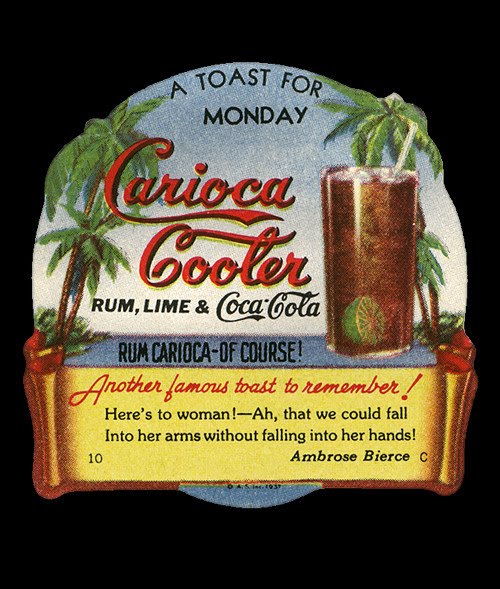
Just for fun, here is a comparison of the official Coca-Cola logo, in force as a protected trademark since 1893, and the logo treatment for American Spirit's Carioca Cooler concoction. You be the judge.

Coca-Cola brand protection history

I'm starting to look into the history of The Coca-Cola Company's trademark protection efforts. This six-minute video by Babson College professor Ross D. Petty doesn't mention Carioca, but describes the company's aggressive efforts to legally block competitive products and unauthorized trademark usage.

Thursday, September 23, 2010

Angels In the Outfield

I added this as a comment to Walter's previous post, but there's enough here to merit making it a full item.

I thanked Walt for providing the link to the article about Bing Crosby's recording of the 1960 World Series. It's a very important development for Pirates fans like us, especially with the 50th anniversary of the Mazeroski homer coming up in a few weeks.

But I imagined readers could have been puzzled about the connection between Walter Ruby and his Carioca Cooler and a baseball game that would be played more than two decades later. Other than the free associations bouncing around in Walter the younger's mind.

So in the interest of helping an innocent reader understand those associations, here's some background.

Walter Ruby (the elder) was acquainted with (but not related to) his namesake Harry Ruby, the songwriter. At one time, we thought that Harry might have written The Carioca song, which was a hit in the 30s, especially after Fred Astaire danced to it in his first starring movie role. (By the way, the carioca in the song though not in Walter's rum is a reference to natives of Brazil.)

Anyway, long story. Harry didn't write that song though he did write numerous other hit songs in the 1920s and '30s. In 1951, he appeared as himself in a cameo role in the Hollywood production of Angels In the Outfield, a movie about a fictional version of, guess who, the Pittsburgh Pirates. Bing Crosby, covered in the article Walter linked to, also appears as himself in the movie, along with a number of real-life ballplayers including Ty Cobb, Joe DiMaggio, and Ralph Kiner. The latter was a star player on the woeful Pirates teams of the early '50s.

Walter Ruby was a sports fan, and he relished popular entertainment, so he would no doubt have enjoyed the movie. Had he lived, he also would have followed the 1960 World Series, but on the wrong side. Having been raised in uptown Manhattan and with his family in the Bronx, Walter was a Yankees man through and through.

Segue here, but this might be an appropriate point to mention that Walter and I were both in Pittsburgh recently for a reunion of the kids who grew up on Green Valley Drive, where we lived at the time of that momentous baseball game. I haven't covered that here on the excuse that our childhood is outside the scope of this blog. However, on reflection, how Stan and Helga lived their lives after the birth of we three children seems entirely relevant.

So one more item for the blog to-do list. I'll have a future report on our reunion weekend.

We Had Em All the Way!

Dan,

Brilliant work! I'm pretty sure thats what got him fired. That's two times Coca Cola comes into Ruby family lore and things turn out badly; let's not forget that our great-grandfather Abraham Bloch (Walter's eventual father in law, who was in the seltzer business in Albany around 1910) was offered the franchise for upstate new York by a small upstart company from Atlanta that offered a syrupy new carbonated drink and he said, "Naw, I've got more than enough business already." For the rest of his life, whenever he had an idea or made a suggestion, people would say, "Yeah, yeah, and you're the guy who said no to Coca Cola." I drank a Diet Coke today (eveybody in Georgia still seems to drink Coke in support of the home team) and it tasted kind of weird to think of all the pain and grief those corporate SOBs caused our family!

On a happier note, see this New York Times article on Bing Crosby's vintage taping of Game 7 of the 1960 World Series, which ends, of course, with Bill Mazeroski's epic game winning blast! 50 years ago in just a couple of weeks! Time flies when you're having fun. Certainly that was one of the very happiest moments of my life; the purest ecstasy and exaltation. The unheralded, scrappy Pirates upending the mighty imperial awful Yankees. Sublime justice for at least one moment. Miracles do come true, after all.

To paraphrase the Passover song: 'If the only great moment in my life had been Maz's homer slaying the Yankees, that would have been enough!' Not really of course, but its a good line.

Did Coca-Cola endorse the Carioca Cooler?


Walter just called from Savannah GA, where he is on a mixed work-pleasure trip with Tanya, to discuss the latest Walter Ruby developments. I read to him the following expanded version of the snippet published in the previous post, which I had since managed to piece together from multiple searches in Google Books.

You will note an interesting article in connection with the first Fall meeting of the IBA, which meeting was addressed by a well-known wine and liquor authority, Mr. G. Selmer Fougner.


This article leaves no doubt that the Carioca Rum Company is very closely associated with the Coca Cola Company in the promotion of a drink known as the Carioca Cooler. The presence of Mr. Homer Thompson of the New York Coca- Cola Bottling Company, at this meeting, is further indicative of the association.


Naturally, the writer is at quite a loss to understand your statement to him at the time of our meeting several months ago, at which you stated definitely that the Coca-Cola Company had no association whatsoever with the Carioca Rum Company and, as a matter of fact, had secured an injunction against these people for the use of the Coca-Cola name and facsimile of the bottle in their advertising."


Appellee's attorneys, in replying to said letter, denied the association with the Carioca Rum Co. referred to in the letter, but attention is called to it here for the reason that, if appellant's selling agent believed that appellee was interested in a beverage containing rum, it is altogether likely that purchasers of appellant's goods bearing the mark ...

Walter's immediate response: "That's what got him fired."

I hadn't gotten there yet, but it sure sounds right. Consider the timeline.

Walter is managing the Carioca advertising campaign for American Spirits in 1935-6, using an apparent tie-in with the Coca-Cola company. In addition to the cocktail labels published previously, above is the front and back of a miniature Carioca bottle that is available for sale on an Internet auction site.

Not only is Coca-Cola's name and logo prominently used, the Carioca Cooler's own branding mimics the Coca-Cola typography.

Then Walter abruptly leaves the company for unknown reasons. This very interesting snippet from the publication Printers Ink in 1937 shows the company reassigning its advertising account, presumably after Walter's departure.


Then we have the expanded snippet cited above, which appears to come in a legal filing in an 1940 appellate court case involving Coca-Cola's relationship with American Spirits and the Carioca Cooler. It is unclear who is the appellant and appellee.

As Walter the younger speculates, our early-day Don Draper of a grandfather didn't have authorization from Coca-Cola for his hot new marketing idea but went ahead with it anyway. Then the beverage giant sues or brings the hammer down in some other way on American Spirits, Inc. and Walter Ruby is forced out of the company as a result.

For those who didn't get the reference, Don Draper is the lead character in the television series Mad Men about a self-made man in the advertising business in New York the 1960s. Walter Ruby is a self-made man in the advertising business in New York in the 1930s.

By the way, the G. Selmer Fougner mentioned above was a prominent food and wine writer who had a daily column in the New York Sun, the first of the breed of foodie journalists so prevalent today. When you think of the characters like Fougner and songwriter Harry Ruby with whom our Walter crossed paths, it does seem like an episode of Mad Men.

Wednesday, September 22, 2010

Wanted. Name of bon vivant who discovered new rum drink!


Believe it or not, the title of this post was one of the advertising slogans that American Spirits, Inc. registered with the U.S. Copyright Office in 1935 in support of its premium rum brand, Carioca.

Or how about this one? "Who discovered the Carioca cooler?" That's a gimme for anyone in our family. It's Walter Ruby, the vice-president of marketing for the selfsame American Spirits. But why is he writing advertising copy about himself?

Take a look at the whole list of copyrighted phrases. It's from the Library of Congress 1935 Catalog of Copyright Entries, part 1, volume 32 and it turned up as a snippet in a Google Books search.


Then here are two more snippets relating to the history of this drink, the first from an advertising trade journal in 1938 and the second from a court ruling published in a federal legal register in 1940. Both snippets leave you wanting more, but these excerpts are all that is available without tracking down the full documents.

"That such is the fact is mostly because American Spirits, Inc., who sell Carioca Rum, saw an opportunity to identify their fledgling with mighty Coca-Cola and started plugging a mixture dubbed Carioca Cooler back in 1934. Carioca Cooler ..."

"This article leaves no doubt that the Carioca Rum Company is very closely associated with the Coca-Cola Company in the promotion of a drink known as the Carioca Cooler. The presence of Mr. Homer Thompson, of the New York Coca-Cola ..."


Finally, the great graphical cocktail labels at the top of the post are from a collection on the site Arkiva Tropika. They look to me like coasters, and they have these corny toasts on them. Plus, there's the Carioca Cooler recipe right there. These are for Monday and Wednesday. I wonder if there were five more.

Friday, September 17, 2010

Helga's ship manifest and special inquiry

Here are a couple of fascinating new documents also discovered via Ancestry's hinting feature. First is the passenger manifest of U.S. aliens arriving on the SS Guine in New York April 15, 1941, showing Elly and Helga Ringel and Herbert and Hilda Peiser among the passengers. The second is a record of those aliens held for special inquiry, showing those same four names.

Both documents include lots of annotations and data that I have not yet taken the time to fully interepret, but presumably tells the story of the group's initial stop in New York, where they were denied admission to the U.S., but where they gained the documentation that allowed them to enter later through Miami from Cuba. More analysis to come.


Another Seymour Rabinowitz?

Here's one that has had me puzzled for a while but I hadn't delved into it until mentioning it to Harriet on the phone the other day. We've always known of Julius Rabinowitz's two children Abner and Judith, but the family's census records show that there was also an older son Seymour. Now that is odd, one, because we have not heard of him and, two, because Julius had a living brother Seymour and one would have thought that precluded him giving his son the same name.

In the past, when I saw Seymour listed on the family's 1930 census, I thought that perhaps that was brother Seymour Rabinowitz who might have been boarding with them. However, the age is not right since this new Seymour seems to have been born in 1903. Also, there is another 1930 census record with Seymour the truant officer living alone. That Seymour, Harriet's father, was born in 1887.

I had left that alone, but now I see that the younger Seymour is also listed on the Julius Rabinowitz household in 1920, when the elder Seymour is still residing with Lena and a couple of other siblings.

The census pages are shown below. In both cases, only some of the family members are shown since they are on the top lines of the form and the missing family members are on the previous page. I have checked that they are there so you can take my word.

Anyway, from this, I feel we have to conclude that Julius and Anna Rabinowitz had a third child, actually their first, and they named him Seymour. And no he didn't die as an infant, as Harriet theorized, since he appears at age 27 in 1930. We'll have to search and see if we can find any other evidence of his life after that. Since the younger children changed their name to Robbins, perhaps Seymour did as well.


Wednesday, September 15, 2010

Meet Arthur Zimkin (and Rebe Eisenstein)


Readers of this blog know that we've been trying to track down all the lines of the Joseph and Lena Rabinowitz family to find any living relatives and learn what became of our various cousins. A big step ahead came when Harriett Berkowitz, the daughter of Seymour Rabinowitz, came forward. She provided fantastic new information, including her memories of her cousin Arthur Zimkin, who was the only child of Sadie Rabinowitz Zimkin, the oldest daughter of Joseph and Lena.

I was able to follow up on that with some Internet research and learned that Arthur had a son Mark, who lived in Toronto, where his mother Frieda Zimkin passed away in the late '70s. I covered that information in the blog.

Then early this year, I received an email from an Isolde Goldman of Hornell NY, who had read the blog and wanted me to know that she was a member of the Zimkin family and that her older cousin, a Rebe Colman Eisenstein of Hackensack NJ, knew Arthur well and would be willing to share information with me.

I contacted Rebe by mail and within days she reached me by telephone. I could immediately tell that, though elderly at age 90, she was sharp as a tack and full of memories about Arthur and other Rabinowitz family members. I said that I would be in New York in July and she invited me and Walter to come for a visit.


We did visit Rebe at her home in July (she the photo at left). She served us a lovely lunch and shared stories and photographs about Arthur Zimkin and his family, as well as of her own interesting history.

Arthur himself was a photographer, and the image topping this post is a self portrait.

I've delayed reporting on our fascinating meeting with Rebe because I have not yet fully reviewed the three-hour recording. I was not otherwise taking notes and I want to make sure that I get all of her revelations down accurately.

Now that I've posted this preliminary item, I will make it a point to listen to the tape and post the highlights as soon as possible.

Rattner ship manifests

Considering that both Walter and I had spent a good deal of time trying to find the records of our Ratner ancestors' passage to America, the story of how they finally came into our possession is somewhat anticlimactic. Ancestry.com now has a nifty feature of hints that automatically conducts searches and alerts users to information they may not yet have discovered.

Last week I received just such a hint for our great-grandfather Abraham Ratner pointing to an inter-European voyage from Hamburg to the Port of Hull near Liverpool. At first, I was inclined to disregard it: There were many Abram Ratners, and importantly we thought the Ratner name didn't come into use until Abe's arrival in America. Thus, a pre-arrival record for that name would not be him.

The 1890 date was the right year, however, and I clicked through to read more and view the actual document—the "directory" of passengers aboard the Esperanza sailing out of Hamburg on July 2, 1890. My excitement immediately grew as I saw the names of Abram's travel mates, listed as Schifre, age 42, and Rosa, 18. Abram was listed as 20. Exactly the right three names and ages for Abe, his bride Rose and mother-in-law Sophie. Here's the document (click to view close up):


At first, I thought the Esperanza sailed through to New York after a stop in England, but reading closer I realized that they disembarked at the Port of Hull and must have taken a different ship to New York. My quick reading about the Port of Hull supported that thought:
During the period 1836 - 1914, Hull developed a pivotal role in the movement of transmigrants via the UK. During this period over 2.2 million transmigrants passed through Hull en route to a new life in the US, Canada, South Africa and Australia. Originating from Denmark, Finland, Germany, Norway, Russia and Sweden, the transmigrants passed through the port, from where they would take a train to Glasgow, Liverpool, London or Southampton - the UK ports which offered steamship services to the 'New World' they had dreamed of.


On the document, New York is listed as "the aim of the emigration." But where was the record for the second leg of the journey? Easy. Now having the correct last name, the right month and year and departure port, another Ancestry search quickly came up with this passenger manifest for the July 16, 1890, sailing of the SS Teutonic.

Page 1 is included so you can see the cover information and column headings. Schrifre and Abraham Rattner appear about one-third of the way down on the second page, which is actually Page 3 of the manifest.


You'll see Sophie (Schifre) and Abe have the right ages. Oddly she is shown as a citizen of Finland, but that looks to be a random anomaly. More surprising is that Rose is not listed together with her family members. I've taken a quick scan of the rest of the manifest to see if she is listed elsewhere but didn't find her name.

So that remains as a loose end, but still we've made a big step forward in documenting our ancestors' journey to America, including finding an important clue to their previous lives that Walter follows up on in the next post.

Oh, here's a couple images of the Teutonic and a link to the Wikipedia article. She was a new state-of-the-art cruiser at the time of the voyage.


One last comment on why we hadn't found this information before. First, we weren't searching on Rattner. Second, the Esperanza record was not in any database we searched. Third, Ancestry's ongoing acquisitions in its international collections has exposed more existing records to its excellent search technologies. I'm pretty sure that Teutonic manifest must have been discoverable all along but we had missed it because the tools were not as good then as they are now.

Did the Ratner/Tulbowitz family really come from Novocherkassk?


Here is a belated posting, with historical records that should have been placed on the blog three years ago, but that is relevant again following Dan's discovery of the Rattner passenger lists.

Just over three years ago, Tanya and I went to Rostov-on-Don to look for records of the Tulbowitz clan, which we had known from family lore to have lived there prior to Raizl (Rose) (the daughter of Shlomo-Aron and Sifra (Sophie) Tulbowitz) and her new husband Abe Bloch heading out to America in 1890 with Sophie. Shlomo-Aron and their son Eduard follow several years later and the family ended up in Albany.

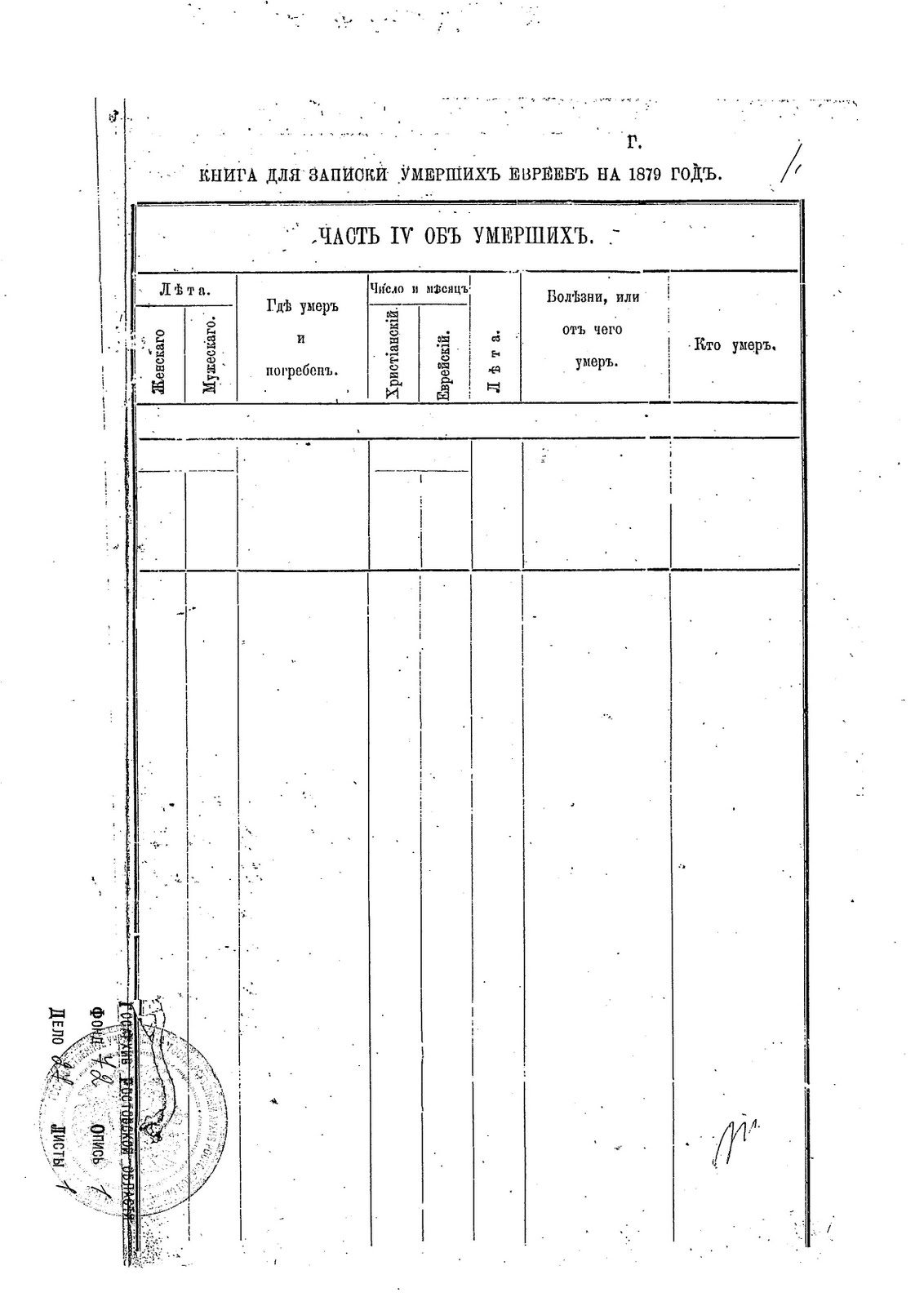
Tanya and I had hoped to find a good number of documents in Rostov, including their address, synagogue membership, a record of the tavern that Shlomo-Aron and Sophie ran—and perhaps something to authenticate the story of Rose having been kidnapped by Cossacks as a child. However the first class genealogist we took on, who worked with us for two days, Yevgeny Gimodudinov found only the two documents seen here, which show in reverse chronological order, the death of Shlomo-Aron and Sophie’s son Isai in 1879 and the birth of another son Gavrill (Gavriel) in 1878.

Somehow, we forgot to put these precious records up on the blog, so are doing it only now. Sorry, everyone. See directly below the English translation of these records done by my life partner and wonderful translator Tanya:
In the Rostov-on-Don metric book of vital records, which listed deceased Jews of 1879, there is a record #41 about the death that occurred on 8/13/1879.

The son of Rechitza Meschanin, Isai Solim-Aronovich Tulbovich, 3 years and 5 months, died of scarlet fever.

Search data: GARO; fund 72; list 1, case 27, Pages 19 - 20.


In the Rostov-on-Don metric book of vital records of 1878, there is a record #100 about the birth of the son Gavriil on 9/28/1878.

Parents: Rezhitsa Meschanin (Vitebsk Gubernia) Solim-Aron Peysakhovich Tulbovich and his wife Sifra-Ita Meerovna.

Search data: GARO; fund 72; list 2; case 14; Page 54.
If one reads my postings from Rostov at the time and then the follow-up postings in the ensuing few months (under Tulbowitzes of Rostov-on-Don, Tulbowitzes of Rezhitsa), one shares the excitement we felt then over the following information gleaned from these two short accounts:

Shlomo-Aron and Sophie Tulbowitz were registered as meschaninee (a social classification that could be translated as ‘townspeople’) from Rezhitsa, a place we were eventually able to identify as being modern-day Rezenke in Latvia (a genealogist in Minsk Belarus, Maxim Mill was able to find records of Shlomo-Aron’s parents Peisach and Sora in the 1850 census in Rezhitsa, together with Shlomo-Aron himself then aged 5.)

So thanks to Gimodudinov’s discovery of these precious documents in the Rostov municipal records, we were able to determine that Shlomo-Aron and Sophie had moved nearly 1000 miles from the northern climes of Latvia to the southern plains of Rostov as a young couple (presumably around 1870 and then depart for the U.S. 20 years later). Until my trip with Tanya to Rostov, no one alive today had any idea where the family had lived before moving to Rostov, which was a late 19th Century boomtown, on the Don River near where it flowed into the Black Sea and a place to which a lot of people, including many Jews, came in search of economic opportunities and increased social mobility, outside the more constricting Pale of Settlement.

We can imagine the family's decision to leave for America about 20 years was greatly influenced by the growing anti-Semitism in the area, which was also the center of the Don Cossacks and had been made a Cossack military province in 1888 by order of the Czar. But first and foremost there was the salient fact (which came to us through family lore) that Abe was apparently in danger of being drafted into the Russian army, a fate he wanted desperately to avoid—and emigration may have been the only way out. They may also have left in search of increased economic opportunity, although they were likely making a better living with the tavern than most poverty-stricken Russian Jews.

Certainly, their meschanin status and other indications that come down to us through family lore give the impression that the family was not without means or upward mobility. Sandy Brenner, our father Stan’s cousin, and the only member of the family who knew Rose who is still with us today, remembers that her grandmother Rose used to tell her proudly that Rostov was the most beautiful city in the world. Also, Rose was said to have preferred speaking Russian, not Yiddish, an indication that as a young girl she wanted to be part of the world of high Russian culture, of Tolstoy and Dostoyevski, and not the shtetl world of Shalom Aleichem. Of course, when she and her husband arrived in the Lower East Side of New York in 1890, Rose saw a real shtetl world and was deeply unhappy, leading Abe, Sophie and Rose to pick up stakes and move to the more all-American, less overtly Jewish environment of Albany, even before Shlomo-Aron and Eduard come over. (We are not sure what happened to Gavriel.)

But to bring this story up to date, several days ago we received startling news via Dan Ruby, who, unlike me, actually peruses Ancestry.com, Jewishgen and the other sites. Here is what Dan found:

This just popped up in my email. It looks promising for Abe, Rose and Sophie's ship manifest, which we've been missing. It shows that they sailed aboard the Esperanza from Hamburg on July 2, 1890, bound for New York via Liverpool. Among the passengers are Schifre (age 42), Abram (20) and Rosa (18) Rattner.

Surprises, if this is them: Their previous residence is listed as Czerkask, not Rostov. Also, they are already using the name of Ratner before their arrival in New York.

- Dan
In subsequent postings Dan finds other records which show that the Esperanza took them only from Hamburg to Hull (near Liverpool in England), from which they sailed to New York two weeks later aboard the ship Teutonic, from Liverpool to New York. Dan, can you put that stuff up on the blog as well?

So Dan’s find brought us not only the exact story of the Tulbowitzes voyage to America—from Hamburg, not Bremen, Germany as had come down to us, with no previous mention of the stopover in England, with some strange added details, such as Schifre being identified as a citizen of Finland, which was then a province of the Russian Empire, not an independent country. It shows that they chose the name ‘Ratner’ for reasons unknown even before they arrived in America; not that it was given to them by a U.S. immigration official at Ellis Island, as we had believed earlier.

Why Abe would have changed his family name from Bloch to Ratner is not known to us, but given that he was of military age and desperate to avoid being conscripted, securing fake documents with a different family name even before he left Russia made eminent sense (According to family lore he crossed the border on a wagon under a haystack, whereas Rose and Sophie came out in normal fashion and met up with him once they were all out). In fact, I knew a fellow in 1990 in Moscow who secured false papers and hid out in his dacha to avoid being taken into the army so such behavior still happens today.

The document unearthed via Ancestry.com also lists the emigrants' hometown not as Rostov as we had always believed, but ‘Cherkassk’ which likely referred to one of two smaller towns close to Rostov; Starycherkassk (Old Cherkassk) or Novocherkassk (New Cherkassk). It happens that I have visited both places, the first in 1992, on my first visit to Rostov to report on the resurgence of the Don Cossack movement in the region in the wake of the demise of the Soviet Union, and the second in 1999 when I was doing some similar reporting. Starycherkassk is a tiny, largely agricultural, stanitza or Cossack village—and so seems unlikely to have been the home of any Jews, including during the late 19th century when anti-Semitism was at its peak.

But Novocherkassk, which was founded in 1805 and is located maybe 30 miles north of Rostov, was, then as now, a larger and more cosmopolitan place, with a large Cossack population, but with a mainstream Russian majority and quite a few Jews, most of whom were rapidly emigrating to Israel and America (that was true in the 1890s as well as the 1990s). For more on Novocherkassk, see the Wikipedia article.

When I visited in 1999, I hung out with Anatoly Iasenik, a fearless Jewish activist and newspaper editor who had built personal and communal ties to a particular local Cossack ataman (leader) who was friendly to the Jews (several of the ataman's competitors had renewed longstanding Cossack anti-Semitism). Several years later Anatoly, whose own life was threatened by powerful business interests whose corruption he had exposed in his newspaper) fled to America and found me by complete accident when he met with Tanya, who then worked at NYANA, a not for profit agency that helped resettle arriving Russian Jews. Anatoly showed her my picture as someone he wanted to locate, and the amazed Tanya said, ‘That’s my significant other.’ When I met Anatoly, he informed me that the ‘good’ Cossack leader he had taken me to meet was later murdered by his rivals.

So Novocherkask was a dicey place in 1999, just as it had been 110 years earlier when Rose (who according to family lore had been kidnapped and held for ransom by Cossacks as a young girl—as an adult she would show family members scars on her legs from an incident when she was accidentally burned by hot water from a samovar during her captivity), Abraham and Sophie presumably left the place and began their ‘honeymoon’ escape to America.

So the historical parallels are compelling and not a little chilling and ESPish, and I feel privileged to have been able to go back there a century later and gain some inkling of the life they must have had then. (I guess that is the book I need to write before too long).

But in any case, if the Tulbowitzes lived in Novocherkassk instead of Rostov, that would explain the dearth of records concerning them in the Rostov archives. Likely they came to Rostov (the capital of the province) for Sophie to give birth to Gavriel in 1878 in a decent hospital, and maybe came back a year later to try in vain to save the life of Isai. That would explain why those two mentions of the Tulbowitzes are found in the Rostov municipal records today, but no other mention of the family, which was presumably living and running their tavern in Novocherkassk. Tanya and I are now going to re-contact Gimodudinov, the Rostov archivist to see if he can go to Novocherkassk to check the records there for mentions of the Tulbowitz family.

But why would Rose have left her grandchildren Stan, Sandy and their descendants with the impression that she came from Rostov, “the most beautiful city in the world”, rather than the decidedly less renowned and glamorous Novocherkassk 30 miles away? Probably for exactly that reason. In Russia, even today, there is a phobia about being ‘from the village’, or ‘from the sticks’ and thereby be seen as a ‘peasant’. Tanya, who was born and raised in the provincial town of Shostka, Ukraine, 300 miles northeast of Kiev, used to tell Americans who would ask where she was from that she hailed from Kiev (where she went to college and subsequently as a young adult) without mentioning Shostka, a rather rough and tumble, working class place about which she had decidedly mixed feelings.

Tanya points out that if she mentions ‘Kiev’ to Americans, they would have heard of it and be able to relate to her origins, but would not have heard of Shostka. But it is also the case that Tanya left Shostka at 18 for Kiev and a better (more cosmopolitan) life, and didn’t necessarily want others to know from whence she came. It seems to me likely that Rose might have been animated by the same way of thinking.

In the meantime, thanks to Dan, we are much closer to figuring out the ‘Tulbowitzes in Rostov (province) story”. We’ll post the news of Gimodudiov’s search of the Novcherkassk records as soon as we have them.

Saturday, October 31, 2009

New Ratner family branch discovered

New information (for us) about a branch of our Ratner family popped up on Ancestry.com, and as a result I have now made a connection with a new second cousin once removed. She is Nicole Richner, a great granddaughter of George Peyser Ratner, the older brother of our grandmother Selma.

We had known about Peyser's daughter Marjorie Decker, and knew that she had been alive in a nursing home near Albany until recently. Walter made an unsuccessful attempt to contact her. We also knew Marjorie had married Robert Ken Decker and that they had two sons, and thus we had conjectured that there could be another generation of Deckers. However, my efforts to discover who and where they were had gone unrewarded.

Then a week ago I am scanning Ancestry for new leads on the Rabinowitz side when I am presented with alerts that new information has been posted about people in my family tree. Clicking through, I see that George Pizer Ratner is a part of a new Decker Family tree that was posted on October 3 by an Ancester member named Nicole Richner. Attached to his record are several familiar census citations that confirmed that this was the same George Ratner that is our great uncle.

Clicking further into the tree gave me several answers to open questions. First, Marjorie passed away at age 91 a year ago, in October 2008. I'm sorry that our project began too late to have reached her when she was able to contribute her memories. (Nicole has her photo albums, though.) Second, we now knew what had become of Marjorie's sons Ronald and Curt.

Well, sort of. Ancestry has a policy of not showing full information about a living people in members' family trees. The tree's owner can allow access to other members to see the full names and personal information, but I was viewing Nicole's tree as an unprivileged user. So all I could see was profiles labeled "Living Decker" for each person. Still, I could deduce that one of the two sons was unmarried and childless and that the other had had six children, three sons and three daughters. Two of the daughters had last names other than Decker, including a Living Alexander and a Living Richner, who had presumably married and taken their husbands' names.

So this living Richner was obviously the Nicole Richner that posted the Decker Family tree. Delighted to have learned this information but wanting to be able to see the full information, I sent off a message to Nicole through Ancestry's Member Connect feature. I identified myself as her second cousin and told her a bit of our Ratner genealogy and asked her to reply.

Today her message came back. Here is an excerpt:

Most of what I have has been due to my grandmother, that you so kindly mentioned in your email. She was an awesome women! I had the opportunity a few years back when both my grandparents were still living to visit with them for a few days. I went specifically to just sit and listen. They were the ones that gave me the framework for every peice of information that I have. I very grateful that I was able to do that. She also sent me her photo albums and other documents that I have yet to fully go through. She had a memory like an elephant. I was amazed at the information that she was able to share.


I've written back again and hopefully soon will be able to get photos and other information about Marjorie's Ratner family. With all the progress we've made about our Rabinowitz family as a result of Harriet finding us, it is exciting that we are positioned to learn more about our Ratners now that Nicole has turned up.

Sunday, September 13, 2009

Graves of Joseph and Lena Rabinowitz

Here are photos of the gravestones of Joseph and Lena Rabinowitz at Mt. Zion Cemetery in Queens. Note that Joseph is identified in both Hebrew and English as "Yehuda Noah" and not Yosef, which raises the question as to why he has come down to us as Joseph. He is also identifed as the son of Abrhaham Yoel and Leah as the daughter of Abraham Yaakov.
I am still working on the Hebrew translation, especially of Joseph's grave, which is quite poetic with the first line saying something like "For these, we are weeping" and the third line something like "From my head fell the crown".
Lena's grave identifies her as "our dear mother" and something like a "woman of righteousness"--but let me get the full translation because I am missing some important stuff from both of them.
Gene and I were moved by the cramped setting with a factory smokestack looking over the old cemetery which is clearly a slightly earlier and decidedly less opulent setting than Mt. Hebron several miles east where Walter and Selma Ruby are buried. More as soon as I get full translations...

Saturday, August 29, 2009

David Zimkin lists Arthur J. Zimkin as next of kin

Ancestry has a host of records for David Zimkin, husband of our great aunt Sadie. We see census records for 1900 and 1910 as well as the 1920 and 1930 we already knew about; draft registration cards for both World War I and II; and his Social Security death index. He died in New York at age 80 in 1966. (Note that he was born in Riga and that there is lots of information available about Zimkins in Latvia, but I don't have time for that now.)

Here is his WWII draft registration. Notice that he lists his only son Arthur J. Zimkin as the "person who will always know your address." Why is this significant? Because it is the first confirmation of Arthur's middle initial, which further links him to that Montreal engagement.


Freida Zimkin died in Canada

We learned from Harriet that Sadie Rabinowitz's son Arthur Zimkin married a Frieda. We have an intriguing 1965 Canadian engagement announcement for Mark Raymond Zimkin, son of Arthur J. Zimkin of New York. Now from Ancestry, below is a Social Security death index for Frieda Zimkin indicating that she resided and received social security benefits in Canada.

(She was age 64 at death. Would she have been eligible for benefits? I looked it up. Eligibility for female workers and widows was extended to age 62 beginning in 1956-—for men in 1961.)

Could be that Mark settled with his wife Phyllis in her hometown of Montreal, and that later his mother Frieda came to live with them. Speculation of course. If true, we'd like to find out if Mark and/or Phyllis are living, and whether they had children.

Name: Frieda Zimkin
SSN: 057-01-5649
Last Residence: 953 (U.S. Consulate), Canada
Born: 31 Dec 1912
Last Benefit: 953 (U.S. Consulate), Canada
Died: Jul 1977
State (Year) SSN issued: New York (Before 1951)

Sharon family 1975

Joanne is in Israel this week visiting with younger generations of the Sharon family. Here is a selection of photos from her visits to Kibbutz Afeq in 1975 and 1985. We'll look forward to a new batch following her trip.

Love to all the Sharon descendants and family as they observe Pnina's shloshim at Afeq tomorrow. 


Monday, August 17, 2009

1965 engagement of Arthur Zimkin's son is announced in a Canadian Jewish newspaper

Unlike some other names that turn up huge numbers of search results, there are not a lot of Arthur Zimkins. The one we are interested in is the son of Sadie Rabinowitz Zimkin and her husband David. Speaking with Harriet Berkowitz over the weekend, she mentioned that Arthur was married to Frieda and that they may have had a child.

I had searched on Arthur before but when I did it again yesterday, this very interesting citation came up. It is the November 5, 1965 edition of The Canadian Jewish Review, in the section on births, deaths, marriages and engagements. Under the heading of Montreal Engagements we see this very interesting announcement:

Mr. and Mrs. Mac Schwartz, 1357 Van Horne Avenue, announce the engagement-of their daughter, Miss Phyllis Penny Schwartz, to Mark Raymond Zimkin, son of. Mr. and Mrs. Arthur J. Zimkin, of New York.
Here is the image (click to enlarge). Look for the Schwartz Zimkin notice in the second column from the right near the top. It isn't necessarily the right one, but the ages are about right and as I say there are not a lot of Arthur Zimkins. This gives us a hopeful lead toward tracking down another living Rabinowitz line.