I upgraded to the new version of the Blogger software today. This will allow a variety of improvements, which I will look at later. But I've already implemented the most important new feature. We are now able to categorize our blog posts according to labels we define. I've quickly gone through and assigned labels to all our old posts. We may want to refine the label wording and assignments later, but already you can go to the label listings in the blog sidebar and select any one to view just the posts relevant to that subject. Any future posts can be assigned to one or more of the existing labels or given a new one.
One immediate conclusion from looking at the results is that we have only scratched the surface in producing content for the blog. Maybe that will inspire us to put some new energy into the project.
Tuesday, December 12, 2006

Tuesday, October 31, 2006
Journal publishes Stanley Ruby obituary

Here is the Stanley Ruby obituary from Hyperfine Interactions, as downloaded from the Springer-Verlag library of scholarly journals. Thank you to Gopal Shenoy for making this happen and keeping us informed. It is wonderful to have this assessment by three of Stan's peers of his impact in the physics world.

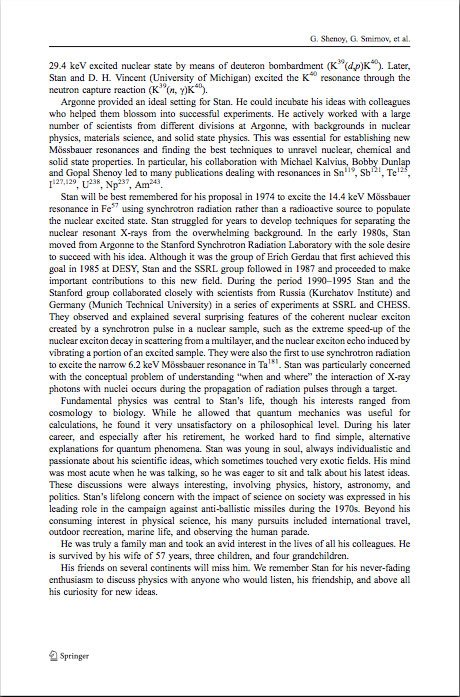
OBITUARY
Stanley Ruby 1924–2004
Gopal Shenoy & Gennadii Smirnov & John Arthur
© Springer Science + Business Media B.V. 2006
Hyperfine Interact
DOI 10.1007/s10751-006-9348-8
Stanley L. Ruby, who made major contributions to Mössbauer spectroscopy and who inspired the community with the idea of observing the Mössbauer effect using synchrotron radiation, passed away on October 18, 2004, in Los Gatos, California. His boundless intellectual curiosity and passion for life was an inspiration to all around him, especially his scientific colleagues.
Born in New York City in 1924, Stan served in the US Army Signal Corps during World War II in New Guinea and the Philippines. He performed his undergraduate and graduate studies at Columbia University, guided in his graduate work primarily by Professor Madame C.-S. Wu.
He briefly worked at the IBM Watson Laboratory before starting his work on Mössbauer spectroscopy with Fe57 in 1960 at Westinghouse Electric Corporation. He collaborated with Paul Flinn (Stanford University) and Gen Shirane (Brookhaven National Laboratory), studying a large class of magnetic compounds. His most recognized work from this period was on the acoustic modulation of the wavelength of resonant gamma radiation, detected using the Mössbauer effect. During a visit to the Weizmann Institute in 1962, he observed the 9.3 keV Mössbauer resonance in Kr83.
Stan joined Argonne National Laboratory in 1964, where he was involved in the discovery of many Mössbauer resonances, including K40. Since this isotope has no radioactive parent, Stan and R. E. Holland (Argonne) observed it by populating the 29.4 keV excited nuclear state by means of deuteron bombardment (K39(d,p)K40). Later, Stan and D. H. Vincent (University of Michigan) excited the K40 resonance through the neutron capture reaction (K39(n, +)K40).
Argonne provided an ideal setting for Stan. He could incubate his ideas with colleagues who helped them blossom into successful experiments. He actively worked with a large number of scientists from different divisions at Argonne, with backgrounds in nuclear physics, materials science, and solid state physics. This was essential for establishing new Mössbauer resonances and finding the best techniques to unravel nuclear, chemical and solid state properties. In particular, his collaboration with Michael Kalvius, Bobby Dunlap and Gopal Shenoy led to many publications dealing with resonances in Sn119, Sb121, Te125, I127,129, U238, Np237, Am243.
Stan will be best remembered for his proposal in 1974 to excite the 14.4 keV Mössbauer resonance in Fe57 using synchrotron radiation rather than a radioactive source to populate the nuclear excited state. Stan struggled for years to develop techniques for separating the nuclear resonant X-rays from the overwhelming background. In the early 1980s, Stan moved from Argonne to the Stanford Synchrotron Radiation Laboratory with the sole desire to succeed with his idea. Although it was the group of Erich Gerdau that first achieved this goal in 1985 at DESY, Stan and the SSRL group followed in 1987 and proceeded to make important contributions to this new field.
During the period 1990–1995 Stan and the Stanford group collaborated closely with scientists from Russia (Kurchatov Institute) and Germany (Munich Technical University) in a series of experiments at SSRL and CHESS. They observed and explained several surprising features of the coherent nuclear exciton created by a synchrotron pulse in a nuclear sample, such as the extreme speed-up of the nuclear exciton decay in scattering from a multilayer, and the nuclear exciton echo induced by vibrating a portion of an excited sample. They were also the first to use synchrotron radiation to excite the narrow 6.2 keV Mössbauer resonance in Ta181. Stan was particularly concerned with the conceptual problem of understanding “when and where” the interaction of X-ray photons with nuclei occurs during the propagation of radiation pulses through a target.
Fundamental physics was central to Stan’s life, though his interests ranged from cosmology to biology. While he allowed that quantum mechanics was useful for calculations, he found it very unsatisfactory on a philosophical level. During his later career, and especially after his retirement, he worked hard to find simple, alternative explanations for quantum phenomena. Stan was young in soul, always individualistic and passionate about his scientific ideas, which sometimes touched very exotic fields. His mind was most acute when he was talking, so he was eager to sit and talk about his latest ideas.
These discussions were always interesting, involving physics, history, astronomy, and politics. Stan’s lifelong concern with the impact of science on society was expressed in his leading role in the campaign against anti-ballistic missiles during the 1970s. Beyond his consuming interest in physical science, his many pursuits included international travel, outdoor recreation, marine life, and observing the human parade.
He was truly a family man and took an avid interest in the lives of all his colleagues. He is survived by his wife of 57 years, three children, and four grandchildren. His friends on several continents will miss him. We remember Stan for his never-fading enthusiasm to discuss physics with anyone who would listen, his friendship, and above all his curiosity for new ideas.
G. Shenoy (*)
Argonne National Laboratory, Argonne, IL, USA
e-mail: gks@aps.anl.gov
G. Smirnov
Russian Research Center “Kurchatov Institute”, Moscow, Russia
J. Arthur
Stanford Linear Accelerator Center, Stanford, CA, USA
Monday, October 23, 2006
The younger Sharons

 Photos from Walter in Israel.
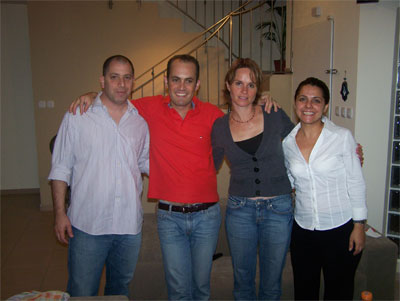 Tal, Achikam, Dalit, Gali (left to right) in Achikam and Gali's lovely new suburban home in Kfar Yona north of Tel Aviv.
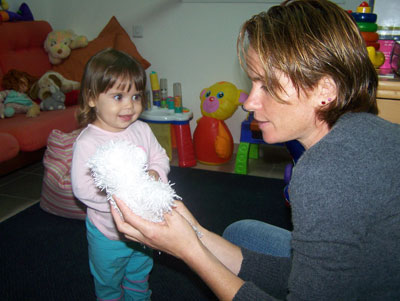 Little Netta (Achikam and Ali's daugher) with Aunt Dalit
Sunday, October 22, 2006
Moving tribute
This is an e-mail I just send to Joanne after reading her wonderful tribute to Stan on his yahrzeit, but then I thought what the hell, I'll put it up on the family history blog as well. Catching a moment in time for posterity and all of that.
Walter
Walter
Jo,
Just read your enormously moving tribute to Dad and broke into tears sitting in my hotel room in Jerusalem. You are so right that the view from their gravesite evokes Hodel's farm--thanks so much for the image. And thanks so much for your compassion and love for our parents and your ability to grieve for them in such a deep and profound way on behalf of all of us. Zeh mashehu dai chashuv, something deeply important that you are doing on a cosmic, existential level that is impacting the world far beyind what we can see and discern (as you can see Israel effects me in all osrts of unexpected ways.
You have warmest regards from the whole Sharon family. I got to visit Achikam's house and hang out with him and his lovely wife Gali and baby girl Netta. Dalit and Tal were there also. Spoke to Pnina, who is pressing Ahikam to travel with her to her birthplace in Belarus as well as Raya, who leaves this weel for a vacation with Amiram in northern Italy. Once homebound in Afeq, they have all turned into world travelers. Anyway, the one question that everyone asked of me (it was more of a demand than a question) was "WHEN IS JOANNE-EE COMING? MATAI HE TAVO? ANACHNU KOL KACH OHEVIM OTAH." So what can I say? You better get on a plane over here ASAP! Dan, the Israeli branch of the family would all love to see you as well.
OK, am on a deadline and must run. I put some of my writing on the Russian conference on rubyjewsday; now I have to write another piece on Lieberman (Avigdor, not Joe), whbich is due immieditely for Jewish Week.
Love,
Walter
Saturday, October 21, 2006
Remembering Stan's last days


Joanne writes:
Standing by his gravesite, I was flooded with my still very vivid memory of Stan's last week. It started on my 50th birthday (Monday) -- not being able to take him home as was the discharge plan, but instead to the hospital. I drove him -- my very, very sick father with a failing heart and failed kidneys sleeping next to me. I remember it feeling a bit surreal; like this could be it, he could go out on me right there rolling up 280, his all time favorite highway, past SLAC, to the exit for Stanford Hospital.
He rallied and made it: a ‘rolling admission” (hospital variety not college) – an in-and- out stay for the very sick elderly who come in from a nursing home and are discharged quickly back to the nursing facility. The dialysis was keeping him going, but not for much longer they predicted. We gathered family and friends.
I invited Peggy, of the Good Death Institute, to meet Stan. He had been so quiet and withdrawn. I just had this sense that if he could become aware of his imminent death, he might choose to use the time he had. He had struggled so desperately his last months with his want to have time, to be awake, not to be asleep when he had so much to write, read, say, share. It had been driving him crazy; how his bio-ryhthms were so out of whack. How the kidney failure affected his cognitive process. As a child with my own sleep issues, he had so stressed the joy of being awake. It just seemed right to bring him this woman who helps the dying person die a good death.
Peggy met him on Saturday afternoon 4ish. Stan had been quiet all day, closed eyes, not responded to anyone including cousins Sandy & Mel, Joe, Gene, Helga, me. Peggy held his hand, rubbed it, told him I'd invited her, and that she came to talk about his heart. He opened his eyes. Looked straight at her and said, “My heart? I can tell you a lot about my heart, but you should hear about my kidneys.” Within minutes Stan was alert, upright, and fully engaged, as we all know he can be, and then asked, 'Who are you?" In finding out she was not a doctor, or nurse, but rather a person who talks with people before they die, Stan looked genuinely puzzled, and said, “die”. “Do you think I’m going to die?”
Peggy later told me she’d never in 20 years of hospice work met a person like Stan, so unaware of dying, and found him absolutely remarkable, brilliant, funny, witty and loveable all at once. They talked about the ways of death, of rituals, of the middle ages, of the big bang and the origins of the universe. Stan, said repeatedly, “I am so enjoying this. Thank you so much, Jo, for bringing her to me. But what do I call you? I need a name for you. I know, I’ll call you the ‘warner’”. He pleaded with Peggy to come back as soon as possible.
She said she’d be there Monday after his dialysis and could stay for a few hours. It was stunning. To have Stan back, his brain woken up, his intellectual curiosity aroused. Most incredible was that Stan was bright on the phone in the morning, and when I arrived Sunday afternoon, he wanted to talk more about the Einstein article in Scientific American. He watched football with Zach and Bill and Dan. He talked to Twyla and Lani. He stayed engaged. He was present. He was looking forward to the next day: Walter was due to arrive at noon, he would go with Stan would go to dialysis, Peggy was coming after that.
Thursday, October 19, 2006
Stan's science legacy
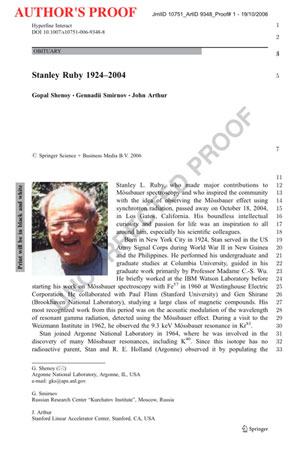
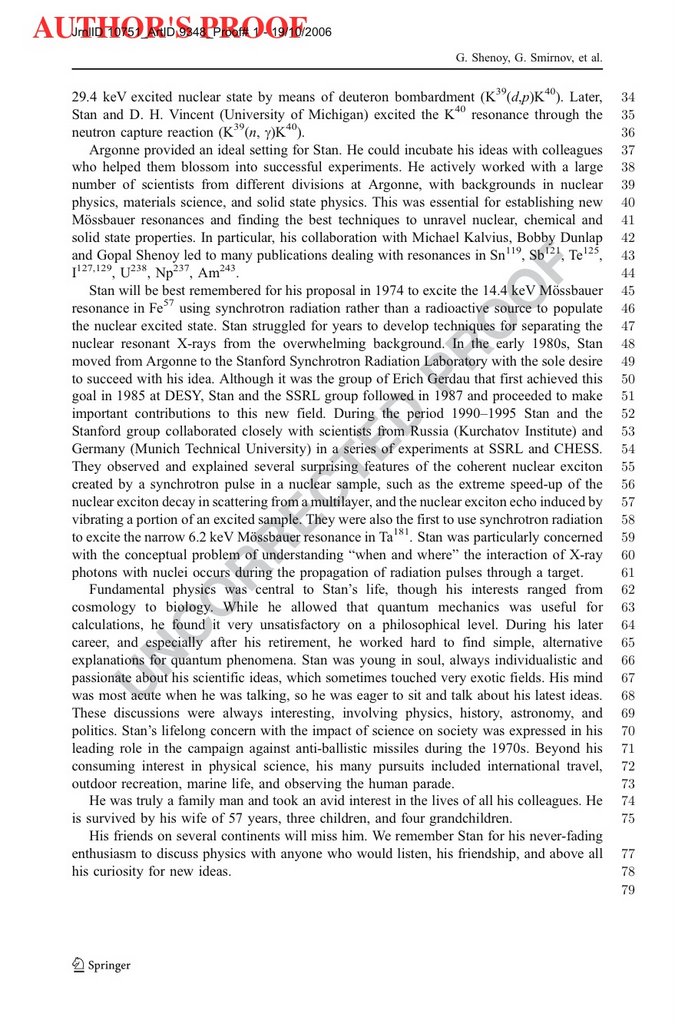
We received a wonderful email today from Gopal Chenoy, a long-time colleague of Stan's from Argonne days who we Ruby kids remember well from his many meals and overnight visits at our home. His message said that the physics journal Hyperfine Interactions would be publishing a tribute to Stan's work in physics written by himself, John Arthur, and Gennaddi Smirnov, two other colleagues. He attached pdfs of the author's proofs of the article, which are reproduced here.
The article puts Stan's legacy as a physicist as clearly as anything we have seen. Here are some excerpts:
His most recognized work from this period [early 1960s] was on the acoustic modulation of the wavelength of resonant gamma radiation, detected using the Mössbauer effect. During a visit to the Weizmann Institute in 1962, he observed the 9.3keV Mössbauer resonance in Kr83.
Stan wil lbe best remembered for his proposal in 1974 to excite the 14.4keV Mössbauer resonance in Fe57 using synchrotron radiationrather than a radioactive source to populate the nuclear excited state. Although it was the group of Erich Gerdau that first achieved this goal in 1985 at DESY, Stan and the SSRL group followed in 1987 and proceeded to make important contributions to this new field.
Fundamental physics was central to Stan’s life, though his interests ranged from cosmology to biology. While he allowed that quantum mechanics was useful for calculations, he found it very unsatisfactory on a philosophical level. During his later career, and especially after his retirement, he worked hard to find simple, alternative explanations for quantum phenomena.
As well as reviewing Stan's scientific accomplishments, the article gives an appreciation of him as a co-worker and man in the world. After the article appears in the journal, I'll put up a link to it or reprint the text. Gopal says he has also submitted a proposal for a longer article on Stan's science legacy that has not yet been accepted for publication.
All of this was wonderfully timely, since we're observing Stan's Jahrzeit this week. Joanne has lately visited with several of Stan and Helga's close friends. She and I will go to synagogue to say kaddish tomorrow. I'll ask Joanne if she wants to post some of her thoughts.
In the meantime, thanks so much to Gopal for this unexpected gift today.
Wednesday, August 30, 2006
Walter's Israel journal (Part 6): Coming home
This is the final installment of Walter's report on his recent Israel trip. Although it only peripherally about our Israeli relatives, it sounds as if it could be the opening of a new chapter of Ruby family history.
As for myself, I made a decision during my two days visiting my cousins in Afeq and sitting with residents in the air raid shelters of Haifa; namely that someday in the not-too-distant-future I will return to live in the hometown of my youth, stricken now, but still achingly beautiful as it sits resplendently on the steep slopes of Mt. Carmel.
Over 25 years ago, I made a decision not to stay permanently in Israel despite my abiding love for the land, the people, the Hebrew language and the primal intensity of the place. I felt myself too much of a cosmopolitan Jew to stay permanently in a place that then seemed to me parochial and intensely nationalistic, and I was unready to join the IDF and take part in enforcing an occupation of the West Bank and Gaza that I found to be fundamentally wrong and immoral. Or so I rationalized it to myself then, yet somehow I have known in my bones during all the ensuing years that Israel is where I belong.
And then suddenly last week, listening to my aunt Penina narrate the story of our family and the role they played in the rebirth of the Jewish commonwealth in the land of our forefathers, and listening to Orly Magen express her profound distress on the emotional toll that the latest outburst of violence is exacting on her Etai and whole new generation of Israelis, I vowed to myself that I will return to Haifa to devote the remaining years of my life to doing whatever I can to help transform conflict into reconciliation so that the next generation of Jews and Arabs, Israelis, Palestinians and Lebanese alike, will not have to endure the horrors that have scarred the lives of this generation and the four generations of Israelis and Arabs preceding it.
Suddenly I remembered two things I knew long ago but had somehow since forgotten; that underneath their hard-edged and sometimes truculent exteriors, Israelis are kind, decent and profoundly vulnerable. Also that despite the hell visited upon it by recurring wars, the tiny jewel-like Land of Israel is the most radiantly beautiful place on earth. It is where I belong.
Walter's Israel journal (Part 5): An odd sense of normalcy
Away from the war zone, Walter finds life goes on in Tel Aviv and Jerusalem.
Like almost every Israeli to whom I spoke, Magen (see previous post) said she supports the government’s decision to press on with its military offensive to the Litani River, some 20 miles north of the Israeli-Lebanese border, although, like nearly all the others, she is dubious the expanded offensive will bring lasting peace or end the missile threat that had turned their lives upside down. When the cease-fire was announced several days later, there was an almost unanimous feeling that it would last only a matter of hours or days and then violence would erupt again.
The three quarters of the Israeli population that lives south of Hadera in the region where the missiles have yet to penetrate live in a jarringly different reality than their compatriots further north. In Tel Aviv, Jerusalem and elsewhere in the center and south of the country, life goes on more or less normally. People sit in cafes or to the beach as though the whole nightmarish scene happening a few score miles to the north simply does not exist.
A slogan emblazoned on an electronic billboard overlooking the main Tel Aviv-Haifa highway proclaims, ‘Residents of the North, we are all with you’, yet the slogan seems at least partly hyperbole. When I informed friends in Jerusalem that I had just spent two days in Afeq and Haifa before coming to the capital; most responded with comments to the effect of, ‘You were brave to have done that, but I wouldn’t go there myself in this situation.’
Most of those to whom I spoke seemed to feel they are in enough danger and under enough stress given the reality they are forced to live with in relatively peaceful times as well as times of war—that they don’t need to go in for false heroics. It is enough that they go to work every day to keep the economy running—not to mention being ready, if fate so decides, to sacrifice their children for the good of the country. In addition, many have opened their homes to refugees from the north. So why, they ask, should they go north and dodge missiles themselves?
Walter's Israel journal (Part 4): An encounter in the shelter
Walter hears the sad story of a young Israeli mother.
Inside the hot, dank and overcrowded shelter, Orly Magen, a harried-looking woman of about 25, sat dejectedly in the corner, holding her two and a half year old son Etai. Asked about her situation, Magen explained that several weeks earlier her husband had been called into the reserves and the office where she is employed as a clerk sent its workers home for the interim of the conflict.
After several days in which she and Etai were forced to take shelter ten or more times a day during incessant air raids, Magen decided to take her toddler to Tel Aviv and stay with acquaintances there until things calmed down in the north. Yet after a week, and a half, Magen felt that she had worn out her welcome, and with her meager bank account dwindling rapidly, she was in no position to move into a hotel. Instead, she drove back to Haifa with Etai, and moved in with her mother in the building in which the Hadassah members took shelter (see previous post).
A few days later, a missile landed nearby, totally demolishing Magen’s car. She has been assured by a government official that she will eventually be reimbursed a large portion of the value of the car, but, for the moment, she has no idea when the money will come. After narrating her story in matter-of-fact fashion, Magen’s voice quavered as she said, “I can’t stand any more of this. Etai is being traumatized by the constant air raids and the boom of the rockets when they hit. The situation is completely unbearable.”
Several of the Hadassah women hugged Magen and placed into Etai’s eager hands presents like stuffed animals, crayons and coloring books. Smiling broadly through her tears, seemingly for the first time in days, Magen profusely thanked the visitors and said, “It means a lot to me that there are Jews from America who are willing to come here despite the dangers and be with us at this moment.”
Walter's Israel journal (Part 1): At Kibbutz Afeq
Here is Walter's report after his recent visit with family members at Kibbutz Afeq, which took place during the war with Hezbollah when bombs were falling in the north of Israel. I've broken his article into several pieces for readability. For more of Walter's observations from Israel and Ukraine, see his Ruby Jewsday blog.
I was having lunch with my 87 year old aunt Pnina, her daughter Raya and son-in-law Amiram in the communal dining room on Kibbutz Afeq, listening to Pnina reminisce about how her husband, 89-year-old family patriarch Ze’ev, a refugee from Hitler’s Germany journeyed to the Land of Israel as a teenager in the mid-1930’s and, together with other members of his Zionist youth group, helped to found the kibbutz and to plant orange groves on land located on the coastal plain between Haifa and Acre that was then mostly sand dunes and malarial swamps.
Penina talked movingly about how she herself escaped the Nazi invasion of Poland as a young woman by fleeing to Soviet Russia, where she was interred for several months in a prison camp in Siberia before being allowed to emigrate to Palestine. Finally she spoke about the desprate struggle for survival that was Israel’s War of Independence in 1948, and how Ze’ev and other members of a platoon from Afeq took part in house to house fighting in the battle to capture the ancient seaside city of Acre from Arab forces during the 1948 War of Independence.
Suddenly my absorption in Pnina’s narration of a piece of our family history I have heard many times before but which never fails to fascinate me, was pierced by the unmistakable wail of an air raid siren. Manifesting no discernable sign of alarm, Penina said, “OK, we’ll finish our meal in a little while, but right now we need to get up and walk quickly to the shelter”. So I followed my dynamo of an aunt and about 30 other kibbutzniks out of the dining room and down a flight of stairs to a smallish space underneath the stairwell of the building; an alcove which, it appeared to me, would offer only minimal protection to its occupants in the event of a direct hit by a katushya missile.
We stood against the walls of the shelter for about five minutes, with the kibbutzniks socializing and discussing the latest developments in the war, and then, without waiting for an ‘all clear’ signal, walked back up the stairs and concluded our meal.
As we tarried over coffee and ice cream, I asked Pnina how it felt to have survived the onslaught of the Nazis and the rigors of a Soviet prison camp; to have experienced seven Israeli-Arab wars, including the 1973 Yom Kippur War, during which one of her three children and her her only son, Avinoam was killed; to have participated in the building of a kibbutz from swampland into a thriving entity and to have watched her beloved Israel grow from a struggling entity of 600,000 Jews to one of six million, only to find herself having to run to an air raid shelter in the sunset of her life.
She paused for a moment to consider the question in all of its weight and then said, “Look, I don’t appreciate having to run for the air raid shelter five or more times a day as we have been doing here for the past three weeks, and sometimes I ask myself why I bother to take shelter at all, because I am going to die soon enough anyway. But then I say to myself, ‘I don’t want to give those Hezbollah bastards the satisfaction of killing me.’ So I get up from whatever I am doing when the alarm sounds and head for the shelter.’”
Monday, August 14, 2006
AP: Famous ancestors adorn most family trees
Here's an interesting article from the Associated Press that says that almost everyone descends from a famous ancestor. In our family, that could be the Kovno Rav. The article goes into detail about actress Brooke Shields' pedigree. Among her ancestors are Catherine de Medici and Lucrezia Borgia, Charlemagne and El Cid, William the Conqueror and King Harold II, vanquished by William at the Battle of Hastings.
Even more surprising, according to Irish computer scientist and genealogy enthusiast, Muhammad, the founder of Islam, appears on the family tree of every person in the Western world. Who knew?
Even more surprising, according to Irish computer scientist and genealogy enthusiast, Muhammad, the founder of Islam, appears on the family tree of every person in the Western world. Who knew?
Sunday, August 13, 2006
Twyla turns 21
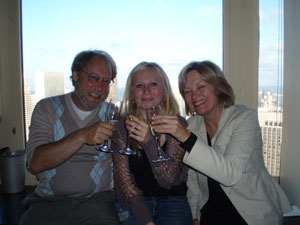
Stan and Helga's first grandchild turned 21 a few days ago. Here's a photo of Twyla, her mom Kate, and her dad Dan enjoying a toast and the view from San Francisco's Top of the Mark.
Thursday, August 10, 2006
Walter posts from Haifa
Walter has been posting updates from Israel at his Ruby Jewsday site. However, his latest report (which he also emailed) is not yet posted at RJD so I'll put it up here:
Yesterday was one of the most exhilarating and profoundy depressing days of my life. I spent the day in Haifa--my beloved hometown where I spent the best years of my life as a young reporter 1976-79, and the city yesterday was achingly beautiful from the vista of Yefe Nof Street--I had forgotten just how beautiful is, but it was almost dead. Hardly any traffic, the port was empty.
A visitor does not see physical destruction, until they take you to a few of the houses that were blown up. I accompanied a group of Hadssah women from the U.S., first to Rambam hospital and then on a tour of the city--which was cut short by air raid sirens again and again. The first siren came when we were inside the hosital, but they insisted that we go inside the conference room where we had been scheduled to go anyway, but a little later, because it is the most secure spot in the hospital. We spoke to several soldiers who had been gravely wounded in Lebanon whose lives were saved by the wonderful; doctors there.
It turned out a rocket had landed a kilomter away friom us, but it didnt explode. Then we began a tour of the nearby Bat Galim neighborhood which was abruptly cut short by another siren and we rushed into the shelter of a nearby rundown apartment building. The shelter was tiny with maybe 30 people crammed shoulder to shoulder in a small space--verry hot and smeeled bad.
Residents of the house were sobbing--a young single mother cradled her 2 year old and said, "I cant take this any more...its been going on for weeks and my nerves are snapping." I asked her why she didnt evacuate to Tel Aviv or somewhere else safe and she replied, "I already went there, but I couldnt impose on people any more, so i came back. I have no money now and nowhere to go". Her car was destroyed in a boming attack. Her mother wailed, "What is goping to happen to us...Please help us."
After we left there we went into another shelter in a parking lot underneath a kenyon (mall) where a mixed group of Jewish and Arab kids were being entertained by musicians beating drums. One Arab counselor shouted, "The jews and Arabs of Haifa stand together. We wont let Nasrallah tear us apart." By the way, everyone I spoke to--mostly non-Russians had learned from Russian-Israelis via the media the meaning of "Nasral" pa Russki and had a good laugh from it. Calling him "shit"is one of the few bright spots of the "matzav" (situation) here.
I saw young Israeli girl soldiers working with the Arab and Jewish kids, helping them to laugh and sing and those girls were so wonderful that at that moment I vowed to myself somethign I havent vowed in 25 years--that I intend to come back and live the remainder of my life in Haifa, where I can make a contribution for the sake of my own people, the Jews, and also for the Arabs and for the peace of the sacred Land we both love and cant manage to share.
I kept breaking into tears throughout the day, but felt uplifted and hopeful. Then on the long bus ride to Jerusalem, my spirits flagged and I felt a sense of hopelessness as i heard of the decision of the cabinet to go on to the Litani--nothing but death and destruction as far as the eye can see. My friends, understand me, I devoutly hope it works. The Israelis have convinced themselves that is the only way and I pray with every fiber of my being that Olmert and company are right and I am wrong. But hevreh, it is so FUCKING painful here, you have no idea. I love Haifa and the people of Israel so much and their world is failling apart. If you are up there, Hashem, get your ass in motion and save the people of Israel, save the world and stop this killing now.
Tuesday, August 08, 2006
Flickr photoset for Lani's bat mitzvah
Walter sent email from Israel requesting current family photos for Dalit and Tal. Here is a quick selection from Lani's bat mitzvah last fall. I will try to put up more photos later.
Sunday, August 06, 2006
Translation update
Rather than sending Walter the hi-res files, I decided I should finally get translations done for the two German documents--Hermann's birth certificate and a 1925 death certificate for an unknown Ringel--that were not previously translated. The birth certificate is heavily annotated with additional information from 1888, three years after the certificate was originally issued. The names of the mother and possibly the father are indicated but are difficult to decipher in the handwritten German script.
I googled for German translation services and found one that handles small personal jobs as well as corporate and legal work. I emailed them yesterday and heard back right away from someone asking for more details on the project. I sent off low-res copies of the documents and am waiting to hear more from them.
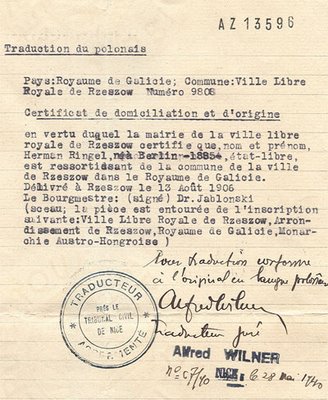
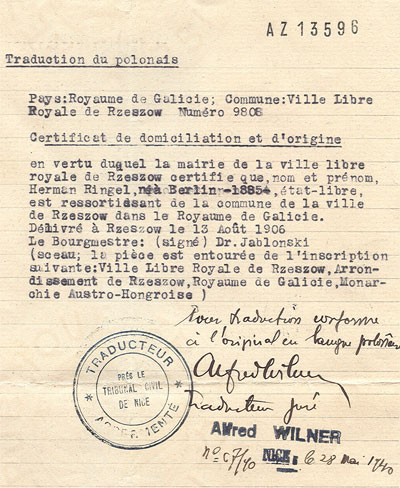
There is one other document for which we need an English translation, Hermann Ringel's 1906 Polish language "domicile of origin" certificate. My German translators don't do Polish, but it doesn't matter because we already have French translation of the document, done perhaps in 1940 in Nice. I will reproduce a closeup of that document (below) that may be legible even in the blog.
But first, here's a theory. Elly carried the Polish domicile record and presented it in France to support her claim of Polish citizenship and use of a Polish passport. Closer inspection of the passport seems to indicate that it was issued in Toulouse in France on July 5, 1940 and would expire after one year. So this suggests that Elly used Hermann's domicile record as documentation to acquire the passport from a Polish consulate in France.
Anyway, the French translation follows. If anyone can render that into English, it would be most helpful.
I googled for German translation services and found one that handles small personal jobs as well as corporate and legal work. I emailed them yesterday and heard back right away from someone asking for more details on the project. I sent off low-res copies of the documents and am waiting to hear more from them.
There is one other document for which we need an English translation, Hermann Ringel's 1906 Polish language "domicile of origin" certificate. My German translators don't do Polish, but it doesn't matter because we already have French translation of the document, done perhaps in 1940 in Nice. I will reproduce a closeup of that document (below) that may be legible even in the blog.
But first, here's a theory. Elly carried the Polish domicile record and presented it in France to support her claim of Polish citizenship and use of a Polish passport. Closer inspection of the passport seems to indicate that it was issued in Toulouse in France on July 5, 1940 and would expire after one year. So this suggests that Elly used Hermann's domicile record as documentation to acquire the passport from a Polish consulate in France.
Anyway, the French translation follows. If anyone can render that into English, it would be most helpful.
On the Kurfürstendamm

I had trouble with the display of this photo in the post below and decided it deserved a post of its own: Hermann and Helga on the Kurfürstendamm in about 1934.

Saturday, August 05, 2006
Hermann Ringel documents
Doh. He was born in Berlin in November 1885. Then the family returned to Galicia, and then he came back in 1906? There are still some mysteries here to unravel. For one, we have not yet had anyone translate the birth certificate, and especially the handwritten annotations.
Here are Hermann's birth certificate and relocation document. I've made them as large as possible in the blog, so I'm sorry they are not very legible. Hopefully I will also be able to get higher resolution versions to Walter.

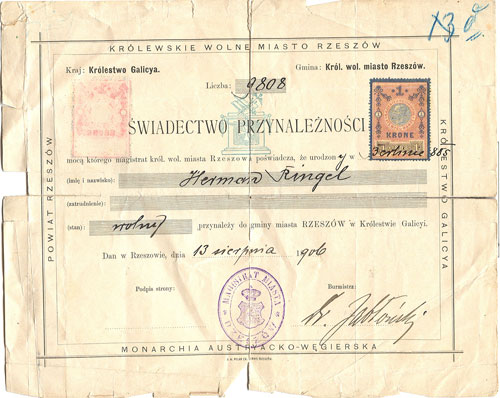
The Ringel dossier
I just spoke to Walter, who departs tomorrow for his trip to Israel and Ukraine. The family gathering day is supposed to be Tuesday, though he is unsure if the latest round of bombings got close to Dalit and Tal's town of Zichron Yachov. I can't wait to get Walter's report on the reunion. Don't forget to take lots of pictures.
To prepare for the meeting, I need to supply Walter with copies of the Hermann Ringel birth certificate and relocation permit, as well as various photos for him to share with the Israeli relatives. The problem is that the documents are really big files--what's the best way to get full-resolution images to him over the wire?
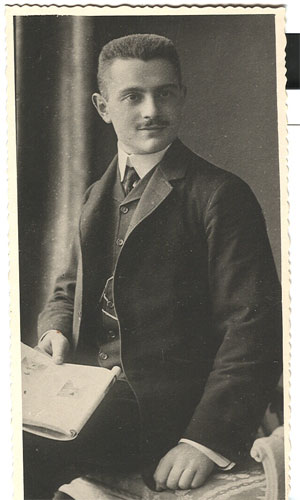
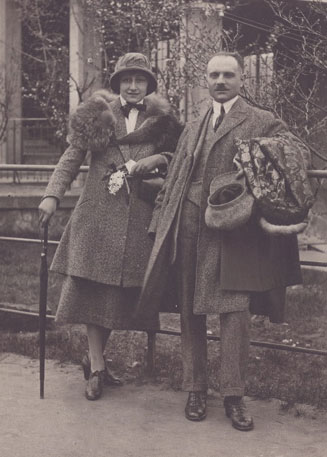
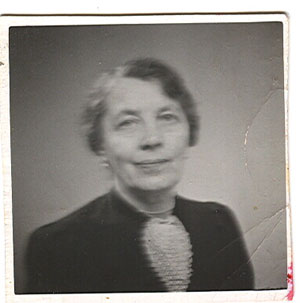
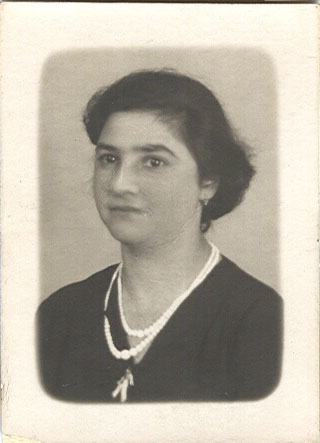
While I mull that over, I'll go ahead and post the pictures that I want to share. Here we have: Hermann Ringel, Herman and wife Elly, Hermann and daughter Helga, Elly's mother Bette Katz (we think), and an unknown Ringel woman (possibly Rosa, Bette or Margot). Only Ze'ev will know any of the people in the pictures, and it sounds as though it is doubtful Walter will be able to see Ze'ev, since he is not well enough to travel from the kibbutz, which is within the war zone.
Friday, August 04, 2006
Family Finder search results are promising
I mentioned that JewishGen Family Finder success story in my last post. Well, I figured, we might as well give it a try. The JGFF database lets you query on surnames, towns and countries to discover other people who are researching those sames names and places. I guess it has been running quite a while and has a large number of researchers indexed.
I ran queries on Tulbowitz in Rostov, Rabinovich in Kaunus, Ringel in Rzeszow, and Wolgemuth in Kaliningrad. Three of the four rang up good hits--only the Tulbowitzes came up blank. There are lots of hits for Rabinovich and Ringel, both fairly common names in their regions of Lithuania and Galicia. We will certainly want to follow up with some of those researchers.
The Wolgemuth hits were more specific--two researchers interested in Wolgemuths in Kaliningrad, the modern name for Konigsberg, then the capital of German East Prussia, where our grandmother Elly was born 1900, Both records are old. Bernice Siegel of Brighton MA last updated her record in 1999. Gary Smith, who does not list an address, updated last in 2001.
I sent each of them an email tonight introducing myself as a descendent of the Julius Wolgemuth-Bette Katz family who had two daughters born in Konigsberg in the early years of the last century. We'll cross our fingers and hope that either or both of the emails finds their destination. If so, it may be that we will find someone who can tell us more about our great-grandfather Julius.
I ran queries on Tulbowitz in Rostov, Rabinovich in Kaunus, Ringel in Rzeszow, and Wolgemuth in Kaliningrad. Three of the four rang up good hits--only the Tulbowitzes came up blank. There are lots of hits for Rabinovich and Ringel, both fairly common names in their regions of Lithuania and Galicia. We will certainly want to follow up with some of those researchers.
The Wolgemuth hits were more specific--two researchers interested in Wolgemuths in Kaliningrad, the modern name for Konigsberg, then the capital of German East Prussia, where our grandmother Elly was born 1900, Both records are old. Bernice Siegel of Brighton MA last updated her record in 1999. Gary Smith, who does not list an address, updated last in 2001.
I sent each of them an email tonight introducing myself as a descendent of the Julius Wolgemuth-Bette Katz family who had two daughters born in Konigsberg in the early years of the last century. We'll cross our fingers and hope that either or both of the emails finds their destination. If so, it may be that we will find someone who can tell us more about our great-grandfather Julius.
Genealogy blog
I came across a good collection of articles and resources at the Jewish section of Genealogy Blog. I may post a few that are relevant to our search.
For example, here is a detailed report about a genealogy success story, in which long lost branches of a Jewish family in Maryland, Uruguay, and the Netherlands are reunited through the Jewish Genealogy Family Finder. So far I have not entered myself in the JGFF, but this article is strong incentive to do so.
For example, here is a detailed report about a genealogy success story, in which long lost branches of a Jewish family in Maryland, Uruguay, and the Netherlands are reunited through the Jewish Genealogy Family Finder. So far I have not entered myself in the JGFF, but this article is strong incentive to do so.
Subscribe to:
Posts (Atom)